
How can we empower citizens to improve nutrition and metabolic health in Switzerland?
There’s no single answer, and no single company, organisation or sector can solve this alone.
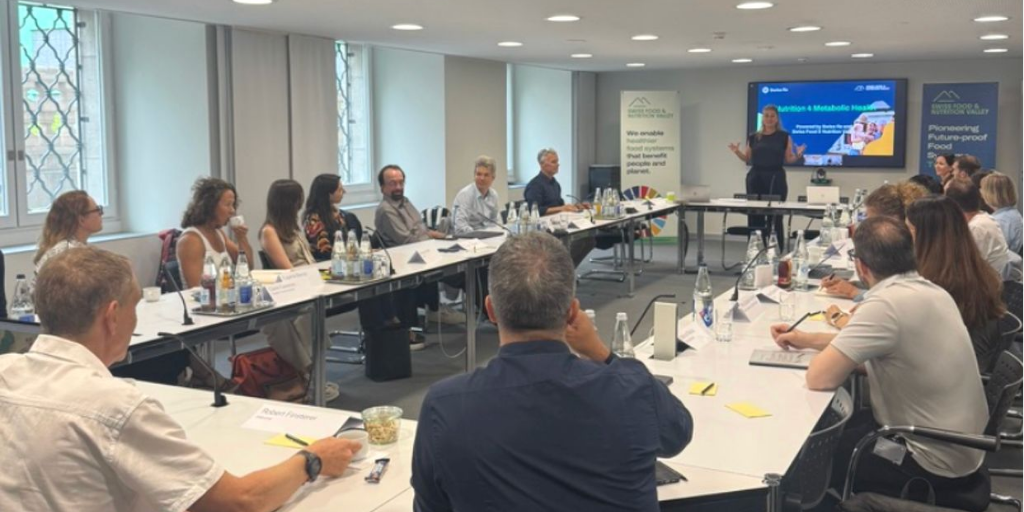
That’s why the latest Nutrition4Metabolic Health brought together producers, academics and food experts at Swiss Re to explore what it will take to move faster from ambition to action.
Building on our previous workshop, we shifted the conversation from identifying the barriers to what we can do to drive action and responsibility across sectors.
Throughout the afternoon, representatives from across the nutrition and health ecosystem came together, spanning food producers and manufacturers, academic institutions, startups, and experts from insurance, food-science associations and government-adjacent advisory bodies.
Organisations represented included, Bühler, Nestlé, SV Group, Hilcona, ETH Zürich, Fachhochschule Bern, University Hospital Zürich, DataBiomix and Alivion, among many others.
Making prevention a priority
Christina Senn-Jakobsen, CEO of Swiss Food Nutrition Valley, opened by setting the scene on Switzerland's health economics: national health costs surpassed CHF 100 billion last year, with 72% of that cost driven by non-communicable diseases (NCDs),which are the largest cost driver, and yet preventable.
She noted that only less than 2% of health spending goes toward prevention, despite research suggesting a roughly 20x return on investment for preventive health spending.
She introduced the initiative's nutritional touchpoints (spanning agriculture, retail, workplace, healthcare, education, and government) and its empowerment framework that prioritises citizen choice over prescriptive mandates.
Rethinking the metabolic health paradigm
Dr John Schoonbee, Swiss Re's Chief Medical Officer, gave a detailed presentation arguing that insulin resistance is a widely underappreciated root cause behind many NCDs.
He argued that the legacy of the mid-20th-century “diet-heart hypothesis” helped establish the low-fat, higher-carbohydrate paradigm that shaped nutritional guidance for decades.
In his view, this has contributed to an underappreciation of the metabolic effects of carbohydrate-rich diets, particularly their role in driving glucose and insulin responses.
John cited startling statistics (U.S. obesity rates rising sevenfold since the 1950s; over half of American adults now diabetic or pre-diabetic) and Swiss data suggesting a substantial undiagnosed pre-diabetic population even among healthy seniors.
The debate around diet, policy and prevention
Five interconnected themes emerged from the discussion, reflecting some of the key challenges in translating nutritional science into policy and practice:
- The credibility and funding gap in official dietary guidelines
- Skepticism toward the "ultra-processed food" classification as scientifically unclear and inconsistently applied
- Changes to the school education curriculum so children have an understanding of healthy habits from a young age
- The economics of who pays for preventive interventions, with Finland's employer-incentive model cited as a possible template
- Tension between sustainability goals and metabolic-health goals with the example of plant-based reformulation that sometimes conflicts with minimal processing
From discussion to action
Next, the attendees split into sector-based groups to consider what their respective industries and institutions could do to advance better nutrition and metabolic health.
Food producers discussed redesigning retail and considered controversial ideas like shifting margins toward healthier products, plus lobbying for tax incentives.
Academia emphasized the need to improve public science communication, and engage more directly with policy makers.
The mixed group flagged the lack of consensus messaging across sectors and the importance of Swiss nutrition bodies being independent from government recommendations.
A drop in the ocean, but the ocean is made of drops
If we really want to improve metabolic health, it can't simply be about telling people to make better choices. We need to make it easier to make better choices.
That means changing the environments, systems and opportunities that people have, and requires action and collaboration across different sectors and ecosystems.
This is the conversation we're continuing through the Nutrition4MetabolicHealth Initiative, as we get ready for our Summit in November.
Get monthly updates in your inbox or register your interest for the Summit.
Never miss a Swiss food innovation morsel.
Latest News

From Policy to Plate: Turning food policy into healthier, lower-carbon meals

The Clima Now launches its “Wall of Fame” as public voting opens today
Earlier this year, Swiss Food &...

The Canton of Fribourg hands over the keys to Agroscope’s new laboratory in Posieux
The Canton of Fribourg officially...

Consumer understanding takes centre stage at Bridge2Food Europe 2026
How do we develop foods that are...