Giulio Busoni: Why the food industry can’t afford to wait on AI

Artificial intelligence is rapidly reshaping industries around the world, from healthcare and manufacturing to finance and retail. But what does it mean for food?
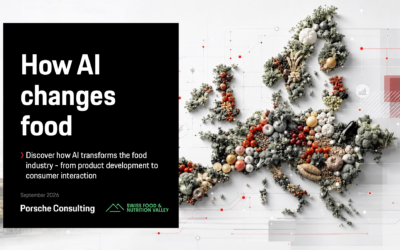
To help answer that question, we partnered with Porsche Consulting to launch AI in Food, a new initiative exploring how AI can help create a more resilient, efficient and sustainable food system. Through events, expert insights, webinars and a flagship report, the initiative will bring together leaders from food, technology, research and innovation to explore both the opportunities and challenges ahead.
To kick off the conversation, we spoke with Giulio Busoni, Partner at Porsche Consulting, who works with leading consumer goods organisations on growth, operations and transformation. Drawing on experience from both within and beyond the food sector, Giulio shares his perspective on why AI matters now, what food can learn from other industries, and why the biggest challenge may not be the technology itself.
Artificial intelligence is rapidly transforming industries worldwide, from healthcare and manufacturing to finance and retail. But what does this mean for the food sector?
Giulio Busoni: A first key perspective is that the food industry no longer evolves in isolation, but within an increasing convergence across industries, most notably with life sciences and sport, centred around the theme of wellbeing and longevity. This dynamic is progressively blurring the boundaries of the consumer experience and is significantly reshaping the competitive landscape of the sector.
At the same time, the European Food & Beverage industry remains in a mature and highly significant economic sector, making a substantial contribution to GDP, employing millions of people, and built on a broad yet highly fragmented production base. It is characterized by a predominance of SMEs and a limited number of large players. The sector is also heavily exposed to international markets, with a
significant share of exports destined for non-European countries, making the ability to innovate in response to global demand increasingly critical.
A distinctive feature of the sector lies in its historical heritage and protected designations of origin, which have traditionally underpinned the competitiveness of “Made in Europe”. However, this protection is gradually weakening, making it increasingly important to adopt tools capable of ensuring traceability of origin, quality, and authenticity.
In this context, artificial intelligence is primarily emerging as an incremental enabler rather than a disruptor of business models. On the one hand, it enables improvements in supply chain efficiency, helping to alleviate pressure on margins; on the other, it enhances responsiveness and operational flexibility in the face of increasingly volatile demand, strengthening forecasting and planning capabilities.
Finally, AI also acts as an accelerator on the demand side: it allows companies to better understand consumer needs at greater speed and to reduce innovation time-to-market, making the sector more agile in an increasingly fast-changing competitive environment.
The food industry is under increasing pressure to improve sustainability, resilience, efficiency, innovation speed, and health outcomes. Why do you believe AI has become such a critical topic for the sector now?
Giulio Busoni: Artificial intelligence is not a new topic for the food industry: companies have been running experiments and pilot projects for several years, often in isolation and without large-scale integration. Today, however, a clear step change is underway, driven by a greater maturity and understanding of AI technologies, as well as by the emergence of early adopters who, having anticipated the shift, are already capturing tangible competitive advantages.
This acceleration is primarily the result of growing structural pressure on the sector. On the one hand, rising costs, across raw materials, energy, labour and logistics, are compressing margins. On the other, there is an increasing need to accelerate innovation and to respond more effectively to demand that is becoming ever more volatile and personalised. These dynamics are compounded by rising operational complexity, increasingly stringent European regulatory requirements, particularly around traceability and sustainability and persistent inefficiencies such as food waste, which continue to generate significant economic losses.
In this context, AI is emerging as a tool capable of addressing multiple challenges simultaneously across the entire value chain. The transition from pilot initiatives to scaled programmes is already visible among leading players, with applications delivering concrete and measurable impact across innovation, planning and operations.
For this reason, artificial intelligence can no longer be viewed as an experimental domain, but rather as a strategic lever essential to sustaining competitiveness in the short to medium term.
You have worked with organisations across multiple industries. What can the food industry learn from more advanced sectors in their AI adoption journey?
Giulio Busoni: A recurring pattern observed across industries is the tendency to launch pilot initiatives with strong initial momentum, which, however, remain isolated and are not designed from the outset with scalability in mind. This represents one of the most significant limitations in AI adoption journeys.
The most critical lesson is that data strategy and technology infrastructure cannot be treated as downstream considerations, addressed only after initial use cases are developed. Instead, they must be planned ex ante. It is essential to establish, from the outset, a structured collaboration between IT and business functions, capable of defining an integrated roadmap that encompasses data preparation, data quality, and the organisation’s ability to leverage data consistently and at scale.
In parallel, it is necessary to develop a use case implementation roadmap aligned with both business priorities and the maturity of the underlying data. This helps avoid a misalignment between strategic ambition and actual execution capabilities.
In the absence of these enabling conditions, pilot projects are likely to remain siloed and difficult to replicate, primarily due to limitations in data maturity or infrastructure. This typically results in marginal impact, extended development timelines, and frequent interruptions in the adoption journey, often leading to the need for programme reassessment or even a full restart.
In essence, more advanced sectors demonstrate that the critical success factor is not the initiation of pilot projects, but rather the ability to create the conditions required to scale them in a systematic and sustainable way across the organisation.
In your view, what does the food industry risk losing if it adopts AI too slowly?
Giulio Busoni: Today, the real distinction is no longer between those who adopt artificial intelligence and those who do not, but rather between organisations that use it in a limited way through isolated pilots and those that integrate it in a scaled and strategic manner across the organisation. In this respect, slow adoption exposes the sector to two primary risks.
The first relates to overall enterprise value and medium-term competitiveness. Within the European agri-food ecosystem, it is evident that companies and start-ups that have embraced AI have experienced significant value creation, demonstrating that this technology enables higher valuation multiples compared to the market average. Remaining outside this trajectory, or outside the ecosystems developing new solutions and synergies, means risking a loss of competitive positioning.
The second risk is operational and affects the entire value chain. Failure to adopt AI translates into persistent cost inefficiencies, from supply chain and manufacturing through to support function, precisely in those areas where processes are most amenable to automation. This is compounded by a decline in attractiveness to talent, who increasingly gravitate towards organisations with more advanced capabilities and forward-looking strategies.
Finally, there are direct implications for top-line performance. Consumers are demanding greater transparency and traceability, elements that are rapidly becoming prerequisites for market access. At the same time, product portfolios are ageing more quickly, requiring continuous innovation that is closely aligned with customer needs and capable of being translated rapidly into go-to-market.
In summary, delayed adoption risks simultaneously undermining enterprise value, operational efficiency, and growth potential.
When organisations begin adopting AI, what is typically the greatest challenge: the technology itself, or the people and processes surrounding it?
Giulio Busoni: The technological dimension does not represent the primary barrier; it is often the most accessible component. The more significant challenge lies in building the necessary capabilities and redefining the role of digital strategy within the organisation.
First and foremost, adopting artificial intelligence requires investment in culture and people. Organisations must develop new skill sets and integrate AI into their business strategy in a structured manner, moving beyond purely internal applications to understand how these capabilities can also create market impact.
From a technological standpoint, models, algorithms and tools are becoming increasingly accessible. The critical issue is how these tools are integrated into business processes and adapted to the specific needs of the organisation. In this context, the make-or-buy decision becomes particularly relevant, that is, whether to develop capabilities internally or acquire them externally a choice with long-term
strategic implications.
Data represents a fundamental asset. The information base that companies have built over time constitutes a genuine competitive advantage, one that can be exponentially enhanced through AI. For this reason, it is essential both to preserve this asset and to develop the internal capabilities required to manage it effectively.
In summary, technology acts as an enabler, but the success of AI adoption ultimately depends on people, capabilities, and the organisation’s ability to embed AI within its processes and overall business strategy.
Switzerland combines excellence in food science, innovation and manufacturing. What opportunity does this create in the context of the AI era?
Giulio Busoni: Switzerland represents a highly favourable environment for innovation, underpinned by a deeply integrated ecosystem that brings together universities, capital, institutions and industry within a shared medium- to long-term vision. This model translates into a high density of talent, with one of the highest concentrations of AI expertise globally.
A distinguishing feature is the role of leading universities, recognised as international benchmarks, which operate in close collaboration with industry. Food science and AI-driven innovation are not developed in isolation within academia, but emerge from joint efforts between universities and corporates, creating a virtuous cycle between research and industrial application.
This is further reinforced by the presence of advanced technology centres established by large companies. These facilities are not exclusively used for internal purposes but are, to some extent, opened up to other players within the ecosystem. This helps lower barriers to entry, particularly for smaller organisations—facilitating access to advanced capabilities and infrastructure.
Overall, Switzerland provides a structurally strong foundation that is already highly enabling for the development of AI in the food sector. At the same time, this potential could be further accelerated through a stronger focus on capital availability and start-up integration, thereby enhancing the system’s ability to generate innovation at scale.
When launching the “AI in Food” initiative, what is one question you believe every leader in the food sector should be asking themselves today regarding AI?
Giulio Busoni: The fundamental question every leader should be asking today is whether artificial intelligence is merely an operational tool or a central pillar of the company’s overall strategy. All subsequent decisions stem from this choice.
Once the strategic positioning of AI has been clarified, a second question becomes critical: whether to build capabilities internally or continue relying on AI as an external service. This decision has direct implications for long-term value creation.
If AI is treated as a peripheral element—confined, for example, to the IT function without meaningful integration with the business—the risk is the proliferation of fragmented initiatives: multiple pilots, separately purchased tools, and uncoordinated applications. In such a scenario, benefits remain incremental and isolated, failing to translate into a strategic impact on the organisation. Moreover, relying predominantly on external solutions raises the risk that both data and the associated competitive value are effectively controlled by third-party providers, limiting the company’s ability to differentiate.
Conversely, positioning AI as a strategic pillar implies investing in proprietary data infrastructure, developing internal capabilities, and enabling the widespread application of AI technologies across all business processes. This approach allows organisations to fully leverage the information assets they have built over time and to unlock a step change in performance and growth.
In essence, the real choice is whether to use AI tactically or to transform it into a structural and sustainable competitive advantage.