Christina Senn-Jakobsen: “We can only transform global food systems in collaboration with the global players”

Christina Senn-Jakobsen: “We can only transform global food systems in collaboration with the global players”

Mirai foods burger

At COP 28, Mariam bint Mohammed Almheiri, UAE’s minister of Climate Change and Environment said that our climate goals simply can’t be achieved without urgently creating more sustainable and resilient food systems. 

On the same day, 134 countries including Switzerland signed a landmark declaration – the first of its kind for the COP process – committing to put food systems and agriculture at the heart of their climate ambitions. A coalition of farmers, businesses and civil society groups – including SFNV partners dsm-firmenich, Nestlé and Tetra Pak – signed a “Non-State Actors Call to Action” that highlights food and agriculture as solutions, and not just drivers, of the global climate crisis and commits to put the declaration into action. 

As a big believer in collaborative approaches, I was thrilled to see partners coming together to put food at the heart of their climate plans. But I also know that top-level commitments like these are often met with a certain level of scepticism. In fact, at events, I frequently hear colleagues ask critical but fair questions about the role of global food system players, and whether they’re doing enough to accelerate transformation. 

In a world where our food systems are responsible for a third of our global greenhouse gas emissions while a third of all food produced is lost or wasted, I understand the frustration and the need for speed. And I also recognise why multinational companies – that represent such a huge part of global supply chains – are seen as part of the problem. But at the same time, I believe that they are an essential part of the solution. 

Why global players are part of the solution

To understand where we are today and where we are going, I think it helps to explore where we’ve come from. Since the industrial revolution, our food system has been geared towards producing safe food at highest output and at lowest cost. Global food players emerged as pioneers that used the latest technologies to provide a growing population with long-lasting, affordable and more convenient choices. But some of these approaches also led to new challenges for the world and its population – something only truly acknowledged by the first climate change legislation which came into force in 1994.

Today, we know that there is a rapidly closing window of opportunity to secure a liveable and sustainable future for all. Geo-political developments have been a wake-up call for the food industry. The global pandemic, the war in Ukraine and the resulting energy crisis, combined with the impact of failed harvests due to extreme weather conditions have exposed the fragility of our food systems. It’s clear that sustainability and positive climate impact must be central to the business models of the future.

The sheer size and geographical coverage of global food system players mean that the actions they take have a huge potential for rapid transformation. Large enterprises have always been experts at using insights to respond to, and stay slightly ahead of, consumer demand. Today, they’re drawing on their broad scientific knowledge, extensive talent pool, their infrastructure and processing capacity and global logistic systems to re-imagine processes and products that align business and sustainability objectives. And they’re investing to scale the solutions that have the biggest impact.  In my opinion, we simply cannot feed the world nutritiously and safely without them. 

But rethinking the way we produce and consume food is not just about launching a few new products in a few key markets. We need systemic change to embed more sustainable practices across global supply chains — from the way food is grown, processed, packed, distributed and marketed to how it is consumed and disposed of. 

Accelerating the transition

In the 13 years that I worked for a multinational company, I witnessed first-hand how company culture and mindsets can shift. Teams recognised the limits of a “not-invented-here” mentality and saw that spotting and acting on win-win synergies is the most successful way of doing business. 

Today, global food system players know that they can’t achieve their objectives in silos. They need to work alongside customers to help them innovate and empower stakeholders across their supply chains to take action, through financial incentives or practical support. They also recognise that, despite their size, they’re still just one partner in a broad and diverse ecosystem and through partnerships with peers, academia and startups they can leverage their complementary strengths and move forward faster. They also operate at local level, working alongside SMEs and connecting into regionally relevant technologies, products and solutions to drive food system sustainability.

Take food waste. According to Project Drawdown, reducing food waste is the number one action that the world can take to mitigate climate change before 2050 – but impact depends on a broad range of interconnected issues from changes in legislation to changes in our shopping habits. From investing in research to tackle post-harvest losses and developing new processing and packaging technology to upcycling byproducts, using intelligent inventory management systems and finding new ways to valorize side streams, large enterprises are developing solutions that reduce supply chain waste and boost products’ nutritional value, while creating new business opportunities. 

Tetra Pak: Transforming food processing to minimise waste 
  • Today, around 40 million tons of brewers’ grain are used as animal feed or as landfill each year and typically one third of every soybean is lost in processing, despite both side streams being rich in fibre and protein.
  • Working alongside food manufacturers, Tetra Pak developed technology to transform spent brewers’ grain into a high-value liquid ingredient and use the whole soybean in plant-based beverages, increasing the fibre content without impacting taste or texture.
  • These measures, alongside others, contribute to their target to achieve a 50% reduction of product loss in best-practice processing lines by 2030.

Regenerative agriculture is another example. The Earth’s soil capacity is declining so dramatically that some experts predict that we have fewer than 60 harvests remaining. Recognising that a significant proportion of their greenhouse gas emissions come from agriculture, many large companies are investing in research, programmes and practical support to drive uptake of regenerative agricultural practices in their supply chains, inspiring farmers to make the transition and mitigating some of the risks they face when stepping out of the standard industrial model. Building on this momentum, many have been involved in shaping the recently announced COP 28 Action Agenda on Regenerative Landscapes, an initiative that will help to share learnings between actors active in this space and broker new partnerships to accelerate progress. 

ADM & Nestlé: Scaling regenerative agricultural practices across supply chains
  • Nearly two-thirds of Nestlé’s global greenhouse gas emissions come from sourcing ingredients – so Nestlé has committed to sourcing 50% of their key ingredients – around 14 million tonnes – through regenerative agriculture methods by 2030. 
  • In July this year, Nestlé and  ADM teamed up to enable regenerative agricultural practices in their wheat supply chain through a combination of financial support and technical resources and assistance.
  • ADM also recently released a comprehensive report summarising their progress in this space, sharing that they’ve enrolled partners working on 2 million acres of farmland to date and they plan to reach 4 million acres by 2025.
A focus on collaboration and co-creation

Of course, global food system players have a lot more work to do and it’s ok if we remind them of their responsibility, given their potential impact. Our understanding of the most effective approaches is constantly evolving. New frameworks, like the EU’s Corporate Sustainability Reporting Directive, will harmonise how we talk about sustainability, boost transparency, and ensure that companies honour their commitments, while helping them to spot new opportunities for innovation. 

For me, the answer lies where this article began: a commitment to collaborate and put words into action – across ecosystems, both nationally and internationally. Whether you’re a startup, a policymaker, a change maker, or a researcher, exchanging and teaming up with large companies could boost your reach and impact. There’s no time to lose and the Valley’s global partners are ready. Let’s co-create. 

Find out more about the Valley’s large enterprise partners 

Our 140+ strong community of Swiss food innovators includes 7 large enterprises. You can read more about their individual commitments and initiatives via the links below. 

ADM | ALDI SUISSEBühlerdsm-firmenichGivaudanNestlé | Tetra Pak

Never miss a Swiss food innovation morsel.

Latest News

Switzerland: small country, big food nation

Switzerland: small country, big food nation

Nadia and Sophie Hanessian

What does it mean to be a food nation? We caught up with experts from Switzerland Global Enterprise, PeakBridge VC and the Food and Agriculture Organization and to explore what Switzerland has to offer on the global stage.

The phrase “food nation” has made a number of appearances in the last few years. In Denmark, it’s the name of a non-profit public-private partnership that raises awareness of the country’s role in shaping a more sustainable and innovative food future. In Scotland and in Norway, it’s been used in key policy documents that set out a vision for a healthier, and more equitable food system that creates the basis for growth and value creation throughout the country.

For us, being a food nation is about committing, as an ecosystem, to collaborate to drive healthier, future-proof food systems that benefit people and planet. It’s about bringing together our world class food innovators to pool our knowledge and expertise and co-create and develop joint Impact Projects. It’s about consciously building the infrastructure needed to facilitate innovation. And, given that the global goals for food system transformation are too complex for any one country to tackle alone, it’s about drawing on synergies with other food nations so we can play to our respective strengths and move the needle faster.

To do this effectively, we need to understand which ingredients make up Switzerland’s recipe for success. The interviews below highlight our strategic location, the strength of our research and development activities, the density, breadth and collaborative nature of our ecosystem and our ability to transform cutting-edge technology into solid, science-backed startups that are reshaping the future of food production, from farm to fork to waste. 

We believe that these qualities will enable us to carve out a space as a scale-up nation – moving beyond identifying the problem and developing the solutions to accelerating the widespread implementation of the technologies and approaches that will bring the future of food a step closer.

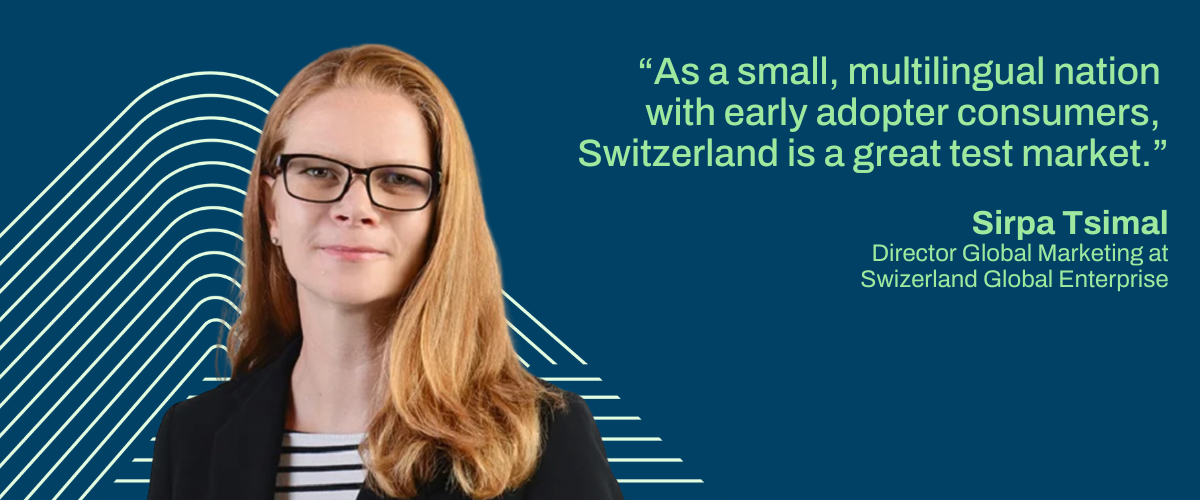
Sirpa Tsimal
Switzerland Global Enterprise

We imagine that foodtech startups often ask you “why Switzerland?”. What do you tell them?

Of course, there’s no single answer because the benefits will be unique to each company’s needs. But I always find that Switzerland’s strategic location at the centre of Europe is a great place to start. Swiss FoodTech companies can leverage this geographical advantage to expand their reach and tap into a global market.

As a small, multilingual nation with early adopter consumers, Switzerland is also a great test market. Not many people know this, but Starbucks actually tested their first coffee shop in Zurich before rolling out across Europe. Consumers in Switzerland are willing to pay a premium for organic and sustainably produced food. So businesses that focus on sustainable sourcing, eco-friendly packaging, and transparent supply chains can definitely find a receptive test market here.

At S-GE’s recent Investment Summit, you talked about the importance of ecosystems. Can you tell us more about how you see Switzerland’s food innovation ecosystem supporting companies that are looking to scale?

Yes, we believe that pooling our knowledge and resources across the ecosystem is vital and collaboration is a key part of Switzerland’s USP. We’re home to a huge range of large food enterprises including Nestlé, Givaudan, dsm-firmenich, and Bühler, providing FoodTech scale-ups with valuable access to expertise and potential joint projects and business collaborations. We have retailers like ALDI SUISSE who are open to putting startup innovations on their shelves and leading universities and companies that are willing to make their facilities available to innovators who need to scale but can’t yet afford to make capital investments.

How do you and your colleagues play a role in helping to lift Switzerland as a food nation on the global stage?

To have all of these factors combined in one place is an incredible asset. We see it as our job to build on these foundations, connect all the players within the network and ensure that Switzerland is able to maximise its global contribution. We do that by interacting with the right people at the right time and ensuring that our story is in the minds of the most important players in the ecosystem. This might be through our global PR work or by co-creating content within our network and together with our regional and cantonal partner organisations. Collaboration – like our partnership with the Swiss Food & Nutrition Valley – is very important to us.

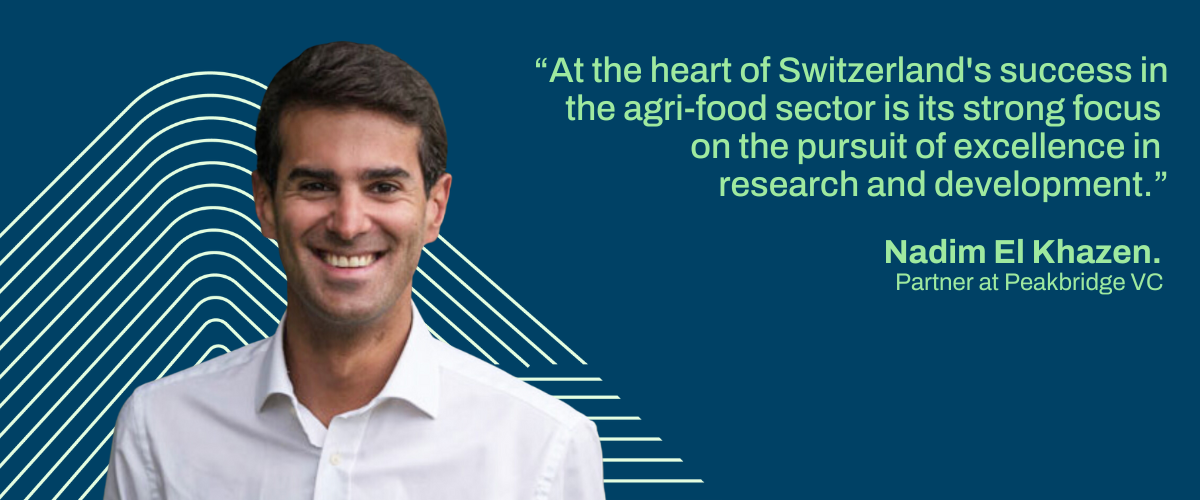
Nadim El Khazen
PeakBridge VC

As an investor, what would you say is the key factor behind Switzerland’s success when it comes to agri-food innovation? 

I would say its strong focus on the pursuit of excellence in research and development. This is driven by a growing number of start-ups that have spun off from the country’s leading universities, such as EPFL in Lausanne and ETH in Zurich. These academic institutions have become true breeding grounds for cutting-edge technologies that are reshaping the future of food production, from farm to fork to waste.

Swiss universities and research institutions collaborate closely with the private sector to pioneer breakthroughs in ingredients innovation, alternative proteins, digitalisation of food chains, water technology, nutrition & health and new farming systems – all of which have profound implications for the global agri-food landscape.

Could you share some examples of innovative technologies and startups in Switzerland that PeakBridge is currently focusing on and investing in?

At PeakBridge – a VC and growth investment fund – we focus on scalable proprietary B2B agri-food technologies. In the field of water technology, Swiss start-ups are developing innovative solutions to address the pressing challenges of mineral water scarcity, quality and the significant carbon footprint of single-use packaging and transportation. In fact, a company like BE WTR from Lausanne has emerged as one of the global disruptors of water distribution.

In nutrition and health, Swiss innovators are at the forefront of creating personalised and functional foods that cater to individual health needs. Through the intersection of biotechnology and nutrition, we see great innovation emerging in two segments: the first one is personalised nutrition and the influence of food on physical and mental health. The second is the use of fermentation to create new fats and proteins which can be analogs or identical to nature but always animal-free.

As food security and the re-localisation of food and water production is on top of governments agendas, Switzerland stands as one of the leading contributors to excellence and innovation in those technologies that will reshape the future of food production and consumption.

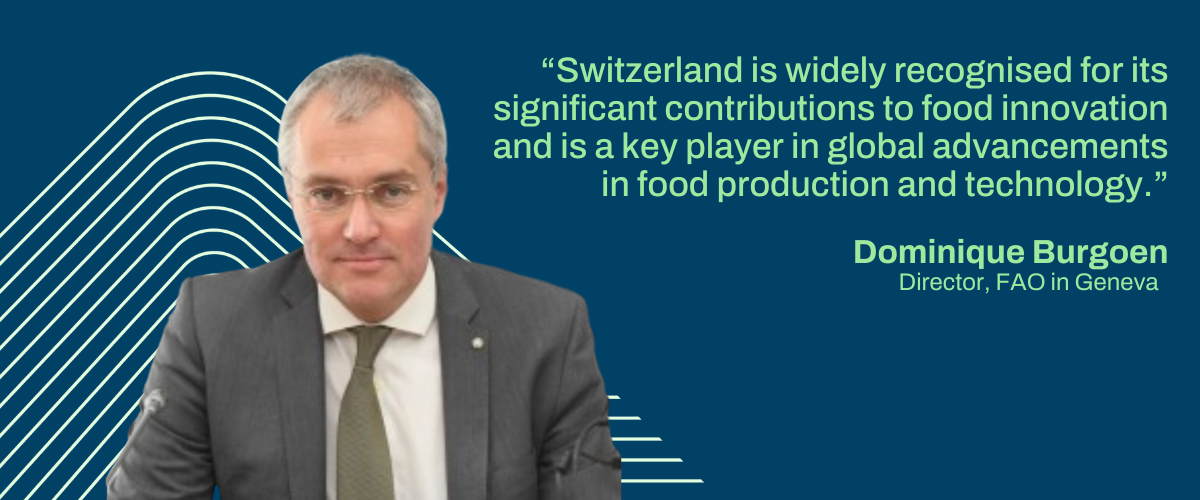
Dominique Burgeon
FAO Office in Geneva

Switzerland is often regarded as a leader in food innovation. How does the FAO view Switzerland’s contributions to global advancements in food production and technology?

Switzerland is widely recognized for its significant contributions to food innovation and is a key player in global advancements in food production and technology. Ranking as the fifth-largest country in terms of research and development activities and hosting major national corporations with global influence, Swiss-based companies play a crucial role in disseminating innovation and technology worldwide.

Switzerland boasts a thriving ecosystem of startups alongside multinational corporations and benefits from its leading technical universities and come up with solutions which could address several challenges regarding food, nutrition, and production in the future. The government actively supports and encourages this innovative environment.

Finally, we’ve also observed a strong emphasis on research and development related to water. Many Swiss companies are leading innovations in clean drinking water, sanitation, and irrigation. These advancements don’t only benefit Switzerland but also have the potential to make a substantial impact in developing countries, ensuring access to clean water and enhancing water productivity in agriculture.

What specific initiatives or programs has the FAO collaborated on with Switzerland to promote sustainable agriculture and food innovation, both within the country and internationally?

FAO has engaged in several important collaborations with Switzerland to advance sustainable agriculture and food innovation, both domestically and internationally. There are, for example, Memoranda of Understanding (MoUs) with Swiss companies and associations aimed at enhancing the transformation of agrifood systems within the private sector. One noteworthy collaboration is with the Kuehne Foundation, which has provided crucial logistical support, knowledge transfer, and training for various agricultural initiatives. This support extends to field operations and logistics management in challenging environments. FAO also has an agreement with SIPPO, the Swiss Import Promotion Programme, to integrate developing and transition countries into world trade.

FAO is now looking to intensify its collaboration with the Swiss private sector to bolster sustainable agriculture and food innovation initiatives. FAO Members have developed a new private sector engagement strategy and, in line with this commitment, Deputy Director-General Beth Bechdol met with private sector representatives earlier this year. We now have a dedicated private sector expert at the FAO Liaison Office in Geneva to facilitate and strengthen ongoing engagement with the private sector, ensuring that these partnerships continue to evolve and contribute effectively to our work around sustainable agriculture and food innovation. And of course, the FAO also cooperates very closely with the Swiss government, both to strengthen relations with the Swiss business sector, as well as in many other programmatic areas.

What role do you see the Swiss private sector playing in supporting the FAO to achieve its objectives?

We see the Swiss private sector potentially playing a multifaceted and vital role in supporting FAO in achieving its objectives across the agrifood system. One key area of collaboration is in nutrition, where several Swiss companies are actively developing solutions to enhance the nutritional content of food, particularly for vulnerable populations. Many companies are also pioneering other initiatives to contribute to more balanced and sustainable diets by, for example, developing plant-based meat alternatives.

When it comes to technology, Swiss businesses contribute to soil preservation and improved agricultural practices through, for example, advanced technologies in soil mapping. This facilitates precision agriculture and more efficient water management. We see this work complementing FAO’s capabilities in geospatial data and in-country resources and aim to foster productive partnerships between Swiss initiatives, FAO and its Members to deliver our shared development objectives.

Switzerland is also home to numerous multinational corporations that play a crucial role in global food production and distribution. For instance, some companies excel in optimising food packaging, particularly for beverages, ensuring product quality and food safety, which aligns with FAO’s efforts to enhance food preservation and quality while minimising contamination risks.

Lastly, Switzerland is a major hub for coffee trade. Approximately 50 percent of the world’s coffee trade flows through Switzerland, and a thriving manufacturing industry makes Switzerland one of the top five coffee exporters globally for finished products by value. This fact alone has far-reaching implications as Swiss companies are essential partners for coffee growers in developing countries. Several players in the coffee value chain are vocal about their commitment to sustainable and equitable value chains, which underscores the importance of stable production and sustainability for the future.

The Swiss private sector’s diverse contributions to agrifood systems transformation present abundant opportunities for continued collaboration – and we look forward to working alongside with the Valley team and industry partners to make this happen.

Never miss a Swiss food innovation morsel.

Latest News

Christina Senn-Jakobsen: An ecosystem-led approach to food system transformation

Christina Senn-Jakobsen: An ecosystem-led approach to food system transformation

Mirai foods burger

Christina Senn-Jakobsen, the Valley’s Managing Director, offers up some food for thought on how a collective, ecosystem-led approach can accelerate food system transformation.

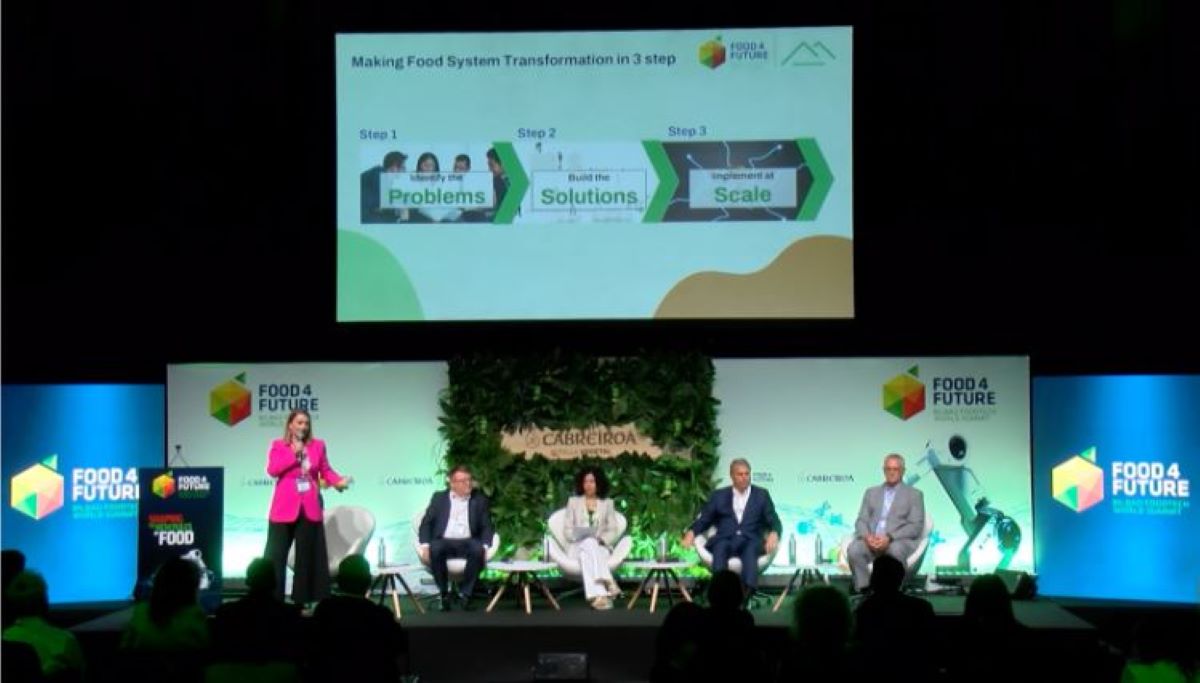
A few weeks ago, I was staring at a blank page. While preparing to attend a panel on “Making Food Production Part of the Climate Change Solution” at the annual Food 4 Future conference, I was struggling to decide which technology to focus on. So I zoomed out to get clarity. And that’s when I decided to focus on the “how” rather than the “what”.

When we talk about the role of food systems in climate change mitigation, discussions often quickly focus on who in the food value chain is responsible. But ultimately, we human beings got ourselves into this mess. Now it’s up to us all to find a way out.

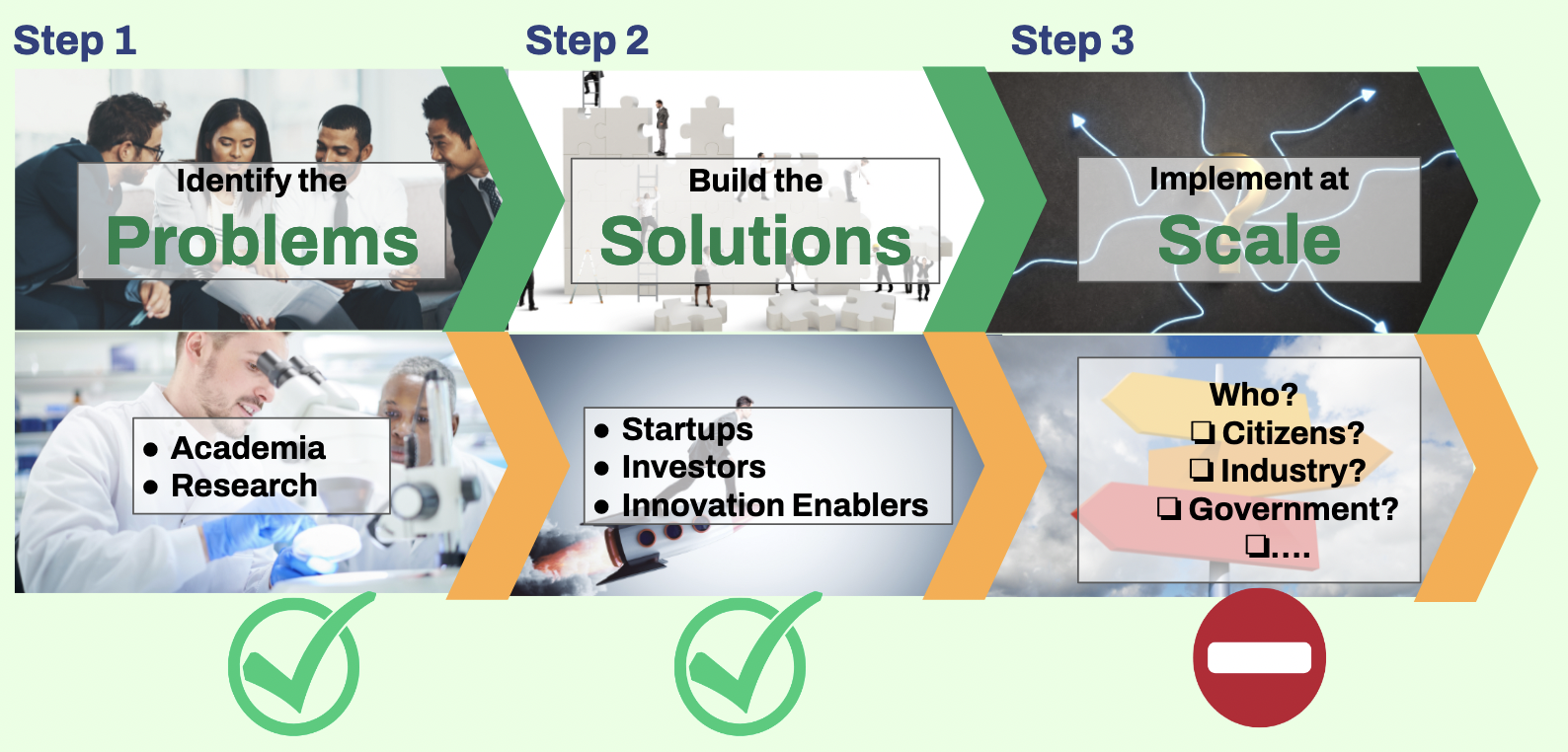
For me, this is about transitioning to an ecosystem-led approach. It’s about combining our strengths and acknowledging how working together increases our impact. This ultimately comes down to three key steps.

1. Identify the problems 

The challenges facing our food system are well-established. We know that at least 30% of the world’s emissions are linked to the food we produce. We know that there are 828 million undernourished people without access to safe and nutritious food, while a further 2.3 billion people are overweight and suffering from chronic conditions such as Type 2 diabetes and cardiovascular disease. And both numbers are increasing dramatically. As our population continues to grow, we know we need to find new ways to produce more with less and cut down on waste along the way. 

Our colleagues in academia and research are doing an amazing job in identifying the problems that lie within our food systems and analysing and quantifying the impacts of these problems. This gives us a great starting point for informed and targeted action. 

2. Build the solutions 

Once the problems are identified, the next step towards transformation is building solutions. Smart, purpose-driven and courageous startups, SMEs, corporates and technology and innovation centers take on the challenge of transforming problems into opportunities. Their creative solutions need to address the initial issue while also working within the complexity of the interconnected global food systems.

“We have the technology to transform our food systems from being a part of the problem to being a part of the solution.”

For every problem identified, a garden of entrepreneurial seeds are planted. Our innovation ecosystems – supported by investors and innovation enablers – provide the water and nutrients that allows an idea to grow. For example, as climate studies reveal the impact of plastic in our oceans, innovators use their expertise and technology to transform algae or xylose from plants into bio-based and sustainable packaging alternatives to plastic. 

We have the technology to transform our food systems from being a part of the problem to being a part of the solution.

3. Implement the solutions at scale 

Steps one and two lay the groundwork. Now we get to the part that truly drives change: implementing solutions at scale. But this is where we’re struggling. 

“We all love engaging with the latest innovation. But implementation and scaling is 95% of the work towards impact.”

Globally, we’ve done amazing work on steps one and two. We all love engaging with the latest innovation, but implementation and scaling is 95% of the work towards impact – both in terms of effort and even more so from an investment perspective. This is the only way we will move the needle, and it’s where we all need to shift our focus right now. 

But why does this matter? The Intergovernmental Panel on Climate Change stated in their sixth assessment report earlier this year that there is a rapidly closing window of opportunity to secure a liveable and sustainable future for all. And the Sustainable Development Report 2023 recently revealed, we’re now halfway to the finish line for Sustainable Development Goals but we’re definitely not on track. 

Switzerland as a scale-up nation

So what can we do? Switzerland may be a small, landlocked country nestled at the heart of Europe, but we’re a big food nation. We believe that our ability to support food businesses to scale is a key part of what we can offer on the global stage. 

Swiss Food & Nutrition Valley brings together over 130 Swiss ecosystem actors from across the food value chain around the premise that we can go further and faster together. Yes, we’re all a part of the problem. But together we can also be part of the solution. 

“Scaling is how we make the transformation happen.” 

In a natural ecosystem, plants, animals, and other organisms, as well as weather and landscape, work together to form a symbiosis of life. An innovation ecosystem should work in the same way. Each actor has something unique to offer and becomes the lifeblood of a thriving food nation. 

There are many key players in our ecosystem. Academia and research provide the technologies, knowledge and talent that sows the seed of a new idea. A startup or an SME develops innovative technologies or a new type of product or service. Then they team up with an accelerator or a government-supported programme to find the right partners. They secure investment to access the capital they need to scale. And they collaborate with a multinational company that can offer them the reach they need to access new markets and work to secure citizen’s acceptance through retail and collaborations with the food service sector.  

The key here is collaboration. Step three requires everyone to work together by contributing their specialised expertise to the system. This is our only chance to get to the sustainable food future we all imagine – in time.

So I’d like to leave you with a request. Sit down with a pen and paper and think about what you can do in your role – both as a professional and as a human – to help scale up the impact of the most promising solutions. Then hang up this note on your fridge or in your office so you don’t forget the power of your potential contribution. Or even better: send it to me. I’d love to hear your thoughts. 

Connect with Christina on LinkedIn.

Never miss a Swiss food innovation morsel.

Latest News