Christina Senn-Jakobsen: 3 key food system challenges and how we can tackle them

 3 key food system challenges and how we can tackle them

By Christina Senn-Jakobsen, SFNV Managing Director

“We have an urgent need for speed, scale, and collaboration if we’re to secure a resilient and livable future on this planet.”

Our food systems are responsible for a third of greenhouse gas emissions and as much as 80% of biodiversity loss. A third of our soil is degraded, our global water budget is under pressure, global temperatures are rising, and the human health crisis is bigger than ever. We’re not on track to meet the Sustainable Development Goals (SDGs), and we’ve already exceeded six of the nine planetary boundaries that keep Earth habitable.

We have an urgent need for speed, scale, and collaboration if we’re to secure a resilient and livable future on this planet. Every day, I have discussions with colleagues across the Swiss and global food innovation ecosystem who are buzzing with ideas and great solutions. But we need to get better at bringing this knowledge together and recognising how collaborative projects can boost our joint impact. Because the issues we’re facing are nuanced. Solutions need to be globally inspired, but locally owned and tailored to each country’s unique challenges.

So where do we start? Here’s my take on three issues where I believe greater collaboration and scaling up the most efficient solutions could really drive measurable impact results. 

  1. Food loss & waste
  2. Unsustainable, unhealthy consumption
  3. Agricultural transformation

Food loss & waste

A third of all produced food goes to waste. Globally, 15.3% (valued at CHF 843 billion) of food never leaves the farm, and in 2019, 17% of total food available landed in rubbish bins, from which it goes on to rot in landfills, producing methane gas and furthering the warming of our planet. 

Impact on environmental and human health

If we stopped wasting food we could reduce global greenhouse gas emissions by 6%–8%, while also reducing land degradation and harm to biodiversity and minimising packaging use. And by diverting food waste to where its needed, we could feed the world. Food produced but never eaten would be sufficient to feed two billion people — more than twice the number of undernourished people globally.

How does this issue differ by region?

Hover your cursor over the image to find out.

How to scale our impact: creating circular solutions

I believe that circular solutions can help businesses reduce costs while improving nutritional value and make it easy and attractive for consumers to make more planet-friendly choices. 

How is Switzerland championing this change?

Here are just a few examples of how Swiss food innovators are innovating to develop circular solutions:

Luya

Luya is transforming Okara – or soy pulp – into juicy, plant-based alternatives.

Upgrain

UpGrain is committed to establishing Brewer’s spent grain (BSG) as the protein and fibre source of the future.

ETH Zurich

ETH Zürich is looking at ways to transform food waste into high-protein animal feed.

SmartBreed

SmartBreed closes nutrient cycles and contributes to environmentally friendly food production. Their insects convert nutrient-rich residual streams from the food industry into valuable proteins and fertilizer.

COOS Change Agency

COOS Change Agency helps municipalities to optimise their local food systems by raising awareness, tackling food waste and improving their supply chains.

ALDI SUISSE

ALDI SUISSE uses an intelligent inventory management system to tackle food waste and offers products close to their expiry dates at a reduced price.

EPFL

EPFL is developing intelligent packaging technologies that tackle food waste while keeping consumers safe.

ECOCASCARA

ECOCASCARA turns coffee farming by-products into healthy, ready-to-drink beverages.

Nestlé

Nestlé aims to reduce nutrient loss across the value chain by, for example, using sorghum side streams as a nutritious ingredient for porridge.

State of Fribourg

The State of Fribourg’s agrifood strategy tackles food waste through its flagship program on biomass valorization

The No. 1 Action! But which part of the value chain can have the most impact?

Project Drawdown says reducing food waste is the number one action the world can take to mitigate climate change before 2050 — but change is needed at every stage of the value chain.

From building waste reduction into production processes to designing waste diversion systems for retail and gastronomy, these are interconnected issues that will require co-creation and legislative enablement.

Governments can establish regulations and incentives that encourage waste reduction across the board, retail and gastronomy can practise better inventory management, and farmers can utilise new tech to better match supply with demand. Consumer behaviour change as a result of education and enablement is critical.

What policy change is needed?

  • Clear nationally-owned strategies that set out tangible objectives that everyone in the ecosystem can rally behind — such as Denmark’s ‘Action plan for circular economy’ and its Think Tank on Prevention of Food Loss and Food Waste – ONE\THIRD .
  • Aligned incentives that reward more circular solutions.

2. Unsustainable, unhealthy consumption

When it comes to diet, I believe that a black-and-white approach isn’t helpful. While many of us are aware of the climate impact of animal product consumption and red meat particularly, the conversation isn’t without nuance and solutions need to be tailored effectively to local contexts. The burden of disease is duel — depending on region and access to quality nutrients, people experience chronic diseases related to undernutrition, such as wasting, stunting, and micronutrient deficiencies, and also of diseases related to excessive calorie intake, such as obesity, heart disease, and diabetes. 

Impact on environmental and human health

Today, twenty of the world’s leading meat and milk producers emit more greenhouse gases than entire industrialised countries such as Germany or France. At the same time, about 10% of the global population regularly go to bed hungry, while WHO recently revealed that more than a billion people worldwide are obese. The World Obesity Federation (WOF) released a report that estimates four billion people will be obese in 2035.

How does this issue differ by region?

Hover your cursor over the image to find out.

How to scale our impact: enabling tasty, affordable and convenient solutions 

Open access, publicly-funded research can help us better understand what consumers are looking for, and policymakers can better regulate how foods are advertised, taxed, and distributed. But ultimately the consumer needs access to a diverse range of tasty, affordable and convenient solutions that make it easier to make healthier and more sustainable choices.

Find out more about how to scale solutions in our latest Impact Digest

How is Switzerland championing this change?

Various Valley partners are working across the value chain to develop new solutions in this space. 

Planted

Planted produces delicious meat from alternative proteins, focusing on the perfect bite and only clean ingredients.

Food2050

Food2050 makes it easy for consumers to see how their meal choices affect their climate impact.

Givaudan

Givaudan provides access to an entire ecosystem of experts, technologies and an integrated portfolio to co-create delicious and authentic plant-based food experiences.

Esmë

Esmë uses a unique stream extraction method of fruits to flavour beverages naturally, with a unique taste and less sugar.

Connie's Kitchen

Connie's Kitchen is reimagining Switzerland's favorite condiments, kicking out the sugar, and packing their sauces with organic, nutrient-dense ingredients like whole fruits, veggies, and healthy oils.

The Cultured Hub

The Cultured Hub AG is accelerating the development of sustainable proteins, specifically cultured meat, fish, seafood, and precision fermentation products.

Vege'tables

Vege’tables empowers people to consume food that is good for their health and the environment.

Planetary

By harnessing the power microbial fermentation, planetary sustainably produces food ingredients and materials.

Which part of the value chain can have the most impact?

Companies developing new products have a huge role to play here. Startups are great at spotting emerging trends and developing innovative products to meet new consumer needs, while larger companies are able to scale the solutions that have the biggest impact.

At the same, food service and retail colleagues need to draw on the wealth of research available about how to make healthier and greener choices more appealing. 

What policy change is needed?

  • Policy-level commitment to publicly funded research in this space.
  • A clear legal framework for novel foods.
  • Applying research-backed strategies to adjust regulations and incentives to make unhealthy food less appealing and boost the availability of healthier options. 

3. A need for agricultural transformation

Without farmers, there is no food. Innovation around harvesting, farming techniques, and relevant technologies will help us mitigate the impact of agricultural activities on human and planetary health. We need to use more farming practices that tread lightly on our planet, with less use of chemicals and a greater emphasis on soil health — but we must co-create these changes with the farmers who feed us. 

Impact on environmental and human health

Unsustainable farming practices wreak havoc on the environment — degrading soil and harming biodiversity. The rampant use of fertilisers and pesticides in conventional farming today results in adverse health effects in humans. 

How does the issue differ by region?

Hover your cursor over the image to find out.

How to scale our impact: resetting incentives

We need to reform agricultural support so that it’s in line with food system transformation goals.

It’s often prohibitively expensive for small farms to switch to regenerative practices. They need access to new and affordable tech, and we must support them — financially, legislatively, and otherwise — in transitioning to environmentally and biodiversity-friendly farming systems. 

I believe that the global players can do a lot to make it easier for smaller players to make this shift. 

How is Switzerland championing this change?

A number of Valley partners are pioneering new approaches to allow us to feed the world more efficiently:

YASAI

YASAI builds and manages vertical farms based on circular economy approaches to transform food systems.

Ecorobotix

Ecorobotix reduces the environmental impact and costs of modern farming with innovative energy-saving machines, such as precision sprayers.

Gamaya

Gamaya provides digital agronomy solutions to enable early detection of diseases and weeds to reduce potential crop losses.

AgroSustain

AgroSustain produces a natural coating that extends the freshness of crops by more than 20 days.

UMAMI

UMAMI designs bio-natural ecosystems and combines them with state-of-the-art technology to produce pure food.

Which part of the value chain can have the most impact?

Policymakers can repurpose subsidies and the private sector can innovate for more efficient and less damaging farming solutions, but citizen demand and action is what’ll drive these players to act.

What policy change is needed?

  • Sanctioned support for sustainable proteins to encourage the scale-up of planet-friendly farming practices.
  • Repurposed subsidies that help farmers restore the health of the land, rather than providing farmers with fertilisers and pesticides.

Interconnected challenges require a collaborative effort

The hidden costs inherent to our current food systems — climate change, resource degradation, and the unaffordability of healthy diets, to name a few — are a byproduct of market, institutional, and policy failures. Addressing the three key challenges discussed above can help to mitigate these costs and increase agrifood systems’ value to society.

It’ll take collaboration across all parts of the value chain to transform food systems so that we produce within our planetary boundaries, but we must place the focus on the role of the consumer in driving demand for sustainable, affordable, and healthy food options. The other ecosystem players — retail, industry, policymakers, and so on — need to understand what support they need to shift what lands on consumers’ dinner plates and design their policies and products to make it easier for them to make healthier and more sustainable choices. 

The reward? Transforming food systems will benefit not just environmental and human health, but could also serve up economic benefits worth USD 4.5 – 9 trillion each year. What are we waiting for?

Never miss a Swiss food innovation morsel.

Agilery and Helbling to drive sustainable innovation for food and beverage brands

Agilery and Helbling to drive sustainable innovation for food and beverage brands

Fruitful AI and Food Brewer
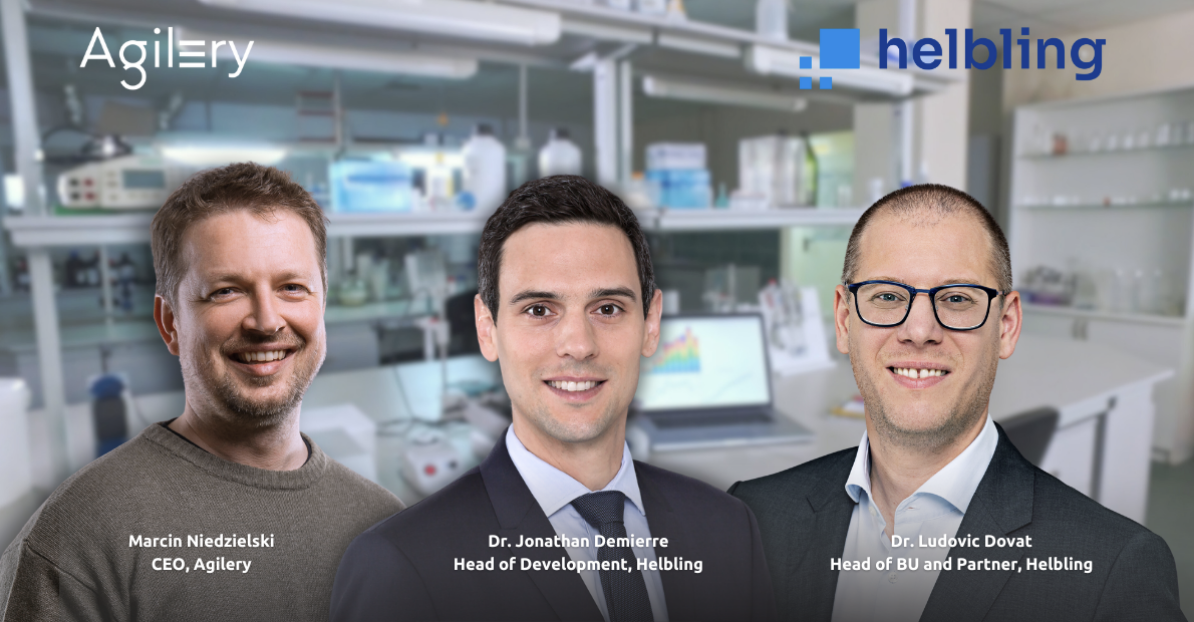
The food and technology industries are increasingly converging. Valley partner Agilery and Helbling saw this as an opportunity to join forces to provide strategic partnership for food brands looking to integrate innovative food and technology solutions. We spoke to Marcin Niedzielski, co-founder of Agilery, Dr. Ludovic Dovat, Head of Business Unit and Partner and Dr. Jonathan Demierre, Head of Development at Helbling to find out more.

📒 The background

SFNV: Tell us a bit about the key issues you address.

Marcin Niedzielski: At Agilery we guide food and beverage brands through the complexities of product creation, production and launch. We recognised that a lot of the brands we work with are working hard to deliver the SDGs around preserving Earth’s ecosystem and ensuring equal and equitable access to healthy diets. We wanted to find new ways to support them.

Dr. Ludovic Dovat: Our work at Helbling is all about creating value by developing more sustainable systems across a broad range of sectors, including the food and beverage sector. By integrating food and technology, we believe that we can create technical solutions that address key global sustainability challenges.

🤩 The opportunity

SFNV: How does working with you contribute to creating innovative sustainable products?

Marcin Niedzielski: We believe that strategic partnerships are the glue that will make the Sustainable Development agenda a reality. By teaming up we’re able to provide our customers with a unique combination of skills and more holistic support.

Dr. Jonathan Demierre: By combining our expertise with Agilery’s we’ll be able to empower food and beverage brands to create products that are both innovative and more sustainable.

🎯  The long term vision 

SFNV: Where do you see the biggest potential for impact?

Marcin Niedzielski: We currently see the biggest potential in relation to promoting responsible sourcing, reducing waste, and enhancing resource and energy efficiency throughout the industry.

Dr. Ludovic Dovat: In future, we’d love to see brands seamlessly integrating food and technology sustainably from the start.

💭 Partner reflections

Marcin Niedzielski: We are excited to collaborate with Helbling on our shared mission to drive sustainability in the food and beverage sector. The partnership will allow us to offer our clients technical and sustainable solutions that align with the SDGs, bringing us closer to a more sustainable future.

Dr. Jonathan Demierre: We believe that by combining our expertise in sustainable technology and product development with Agilery's deep knowledge in food science and manufacturing, we can have a significant impact for our clients and the consumers. Together, we can provide them the services they need to navigate the complex landscape of sustainability and achieve lasting positive changes.

Are you developing a brand that is integrating food and technology - and you want to do it sustainably from the start? Contact hello@agilery.ch or ludovic.dovat@helbling.ch to find out how Agilery and Helbling could support you.

About Agilery

Agilery is a contract manufacturing company that helps brands of all sizes to bring food and beverage products to market.

About Helbling

Helbling is a leader in technological innovation and engineering for food and beverage systems, supporting its clients in all phases of product development and business processes.

Never miss a Swiss food innovation morsel.

IWD 2024: Investing in women, inspiring inclusion

IWD 2024: Investing in women, inspiring inclusion

Nadia and Sophie Hanessian

Just as in other countries around the world, female founders in Switzerland continue to be underrepresented and typically receive less funding than their male counterparts - even when research suggests that companies founded or co-founded by women tend to outperform those started by men alone. This is not only a societal and systemic issue for gender equality - it's also a missed opportunity for the economy.

So, in the run up to International Women’s Day, we wanted to explore what more could be done to inspire inclusion and unleash everyone’s potential to shape the future of food. We spoke to 4 Swiss female founders and innovation enablers to get their take. Here’s what they said.

Ingeborg Gasser-Kriss, Director at Founder Institute Switzerland

“Founder Institute supports female entrepreneurs globally through the Female Founders Initiative. Here in Switzerland, I regularly host a roundtable of women entrepreneurs who share their inspiring stories to encourage other women. I am thrilled that among the 9 graduates of our Fall 2023 cohort, 5 are women! Additionally, we would love to welcome more women entrepreneurs and investors as mentors or speakers in our program - please reach out!”.

Find out more about the Founder Institute Switzerland and apply to be part of their Spring 2024 cohort here.

Eliana Zamprogna, Founder of Yumame Foods AG

"As a female entrepreneur, I am delighted by the growing number of women embracing entrepreneurship with fresh ideas. The business triumphs and the supportive networks we create not only contribute to a prosperous economy but also pave the way for future generations of women to shatter glass ceilings and thrive. I wish for more financial support for businesses led by women today, and envision a future where their success is the norm."

Follow Yumame Foods on Instagram here.

Carrol Plummer, Co-founder and CEO Vivent SA

“As a mechanical engineer and entrepreneur, I deeply believe in creating technology that helps solve major, global issues. I was supported in my early career by some great bosses and in turn I am keen to support and mentor women and minorities to establish exciting careers in technology and STEM. Switzerland is a great place to start a new business and I’m happy to discuss how to get started or what it is like to work as an entrepreneur."

Find out more about how Vivent's solutions let you listen in to what plants are saying here

Sharon Wulff, Co-founder of Agrinorm AG

"As a woman founder, trust your gut amidst entrepreneurship's challenges. Value feedback as input, not directives. Listen, reflect, then decide what's best for your business. Remember, your intuition and understanding of your venture are paramount. Trusting yourself empowers you to make decisions aligned with your vision, leveraging your unique insights as your startup's greatest asset."

Find out more about Agrinorm's smart quality chain management solution here.

Never miss a Swiss food innovation morsel.

Hidden costs of global agrifood systems worth at least $10 trillion

Hidden costs of global agrifood systems worth at least $10 trillion

Image of the Yumane team

Our current agrifood systems impose huge hidden costs on our health, the environment and society, equivalent to at least $10 trillion a year, according to a ground-breaking analysis by the Food and Agriculture Organization of the United Nations (FAO), covering 154 countries. This represents almost 10 percent of global GDP.

The State of Food and Agriculture 2023

According to the 2023 edition of The State of Food and Agriculture (SOFA), the biggest hidden costs (more than 70 percent) are driven by unhealthy diets, high in ultra-processed foods, fats and sugars, leading to obesity and non-communicable diseases, and causing labour productivity losses. Such losses are particularly high in high- and upper-middle-income countries.

One fifth of the total costs are environment-related, from greenhouse gas and nitrogen emissions, land-use change and water use. This is a problem that affects all countries, and the scale is probably underestimated due to data limitations.

Low-income countries are proportionately the hardest hit by hidden costs of agrifood systems, which represent more than a quarter of their GDP, as opposed to less than 12 percent in middle-income countries and less than 8 percent in high-income countries. In low-income countries, hidden costs associated with poverty and undernourishment are the most significant.

More tracking to drive effective mitigation

The report makes the case for more regular and detailed analysis by governments and the private sector of the hidden or ‘true’ costs of agrifood systems via true cost accounting, followed by actions to mitigate these harms.

There have been other attempts at measuring the hidden costs of agrifood systems, producing similar estimates as FAO. The new FAO report, however, is the first to disaggregate these costs down to the national level and ensure they are comparable across cost categories and between countries.

For the first time ever, FAO will dedicate two consecutive editions of The State of Food and Agriculture to the same theme. This year’s report presents initial estimates, while next year’s will focus on in-depth targeted assessments to identify the best ways to mitigate them. Governments can pull different levers to adjust agrifood systems and drive better outcomes overall. Taxes, subsidies, legislation and regulation are among them.

A call to action

Commenting on the publication of the report, FAO Director-General QU Dongyu said, “In the face of escalating global challenges: food availability, food accessibility and food affordability; climate crisis; biodiversity loss; economic slowdowns and downturns; worsening poverty; and other overlapping crises, the future of our agrifood systems hinges on our willingness to appreciate all food producers, big or small, to acknowledge these true costs, and understand how we all contribute to them, and what actions we need to take. I hope that this report will serve as a call to action for all partners – from policymakers and private-sector actors to researchers and consumers – and inspire a collective commitment to transform our agrifood systems for the betterment of all,”

The report urges governments to use true cost accounting to transform agrifood systems to address the climate crisis, poverty, inequality and food security. It notes that innovations in research and data, as well as investments in data collection and capacity building, will be needed to scale the application of true cost accounting, so it can inform decision-making in a transparent and consistent way.

Switzerland: high costs relating to the burden of disease

The figures set out in the report reveal that Switzerland's climate cost are proportionately comparable with other Western European countries. The hidden costs on our land are lower (1% compared with 4% Western European average) but nitrogen costs are higher (12% compared with 8%). Switzerland's hidden social costs, just like other European countries, were calculated to be minimal, but costs resulting from the burden of disease due to dietary patterns were higher than the global average (84% compared with 73%), calculated to be in the region of 18,781 million each year.

Read the full report | Explore the interactive story

About FAO

The Food and Agriculture Organization (FAO) is a specialized agency of the United Nations that leads international efforts to defeat hunger. Their goal is to achieve food security for all and make sure that people have regular access to enough high-quality food to lead active, healthy lives. With 195 members - 194 countries and the European Union, FAO works in over 130 countries worldwide.

Never miss a Swiss food innovation morsel.

Switzerland: small country, big food nation

Switzerland: small country, big food nation

Nadia and Sophie Hanessian

What does it mean to be a food nation? We caught up with experts from Switzerland Global Enterprise, PeakBridge VC and the Food and Agriculture Organization and to explore what Switzerland has to offer on the global stage.

The phrase “food nation” has made a number of appearances in the last few years. In Denmark, it’s the name of a non-profit public-private partnership that raises awareness of the country’s role in shaping a more sustainable and innovative food future. In Scotland and in Norway, it’s been used in key policy documents that set out a vision for a healthier, and more equitable food system that creates the basis for growth and value creation throughout the country.

For us, being a food nation is about committing, as an ecosystem, to collaborate to drive healthier, future-proof food systems that benefit people and planet. It’s about bringing together our world class food innovators to pool our knowledge and expertise and co-create and develop joint Impact Projects. It’s about consciously building the infrastructure needed to facilitate innovation. And, given that the global goals for food system transformation are too complex for any one country to tackle alone, it’s about drawing on synergies with other food nations so we can play to our respective strengths and move the needle faster.

To do this effectively, we need to understand which ingredients make up Switzerland’s recipe for success. The interviews below highlight our strategic location, the strength of our research and development activities, the density, breadth and collaborative nature of our ecosystem and our ability to transform cutting-edge technology into solid, science-backed startups that are reshaping the future of food production, from farm to fork to waste. 

We believe that these qualities will enable us to carve out a space as a scale-up nation - moving beyond identifying the problem and developing the solutions to accelerating the widespread implementation of the technologies and approaches that will bring the future of food a step closer.

Sirpa Tsimal
Switzerland Global Enterprise

We imagine that foodtech startups often ask you “why Switzerland?”. What do you tell them?

Of course, there’s no single answer because the benefits will be unique to each company’s needs. But I always find that Switzerland’s strategic location at the centre of Europe is a great place to start. Swiss FoodTech companies can leverage this geographical advantage to expand their reach and tap into a global market.

As a small, multilingual nation with early adopter consumers, Switzerland is also a great test market. Not many people know this, but Starbucks actually tested their first coffee shop in Zurich before rolling out across Europe. Consumers in Switzerland are willing to pay a premium for organic and sustainably produced food. So businesses that focus on sustainable sourcing, eco-friendly packaging, and transparent supply chains can definitely find a receptive test market here.

At S-GE’s recent Investment Summit, you talked about the importance of ecosystems. Can you tell us more about how you see Switzerland's food innovation ecosystem supporting companies that are looking to scale?

Yes, we believe that pooling our knowledge and resources across the ecosystem is vital and collaboration is a key part of Switzerland’s USP. We’re home to a huge range of large food enterprises including Nestlé, Givaudan, dsm-firmenich, and Bühler, providing FoodTech scale-ups with valuable access to expertise and potential joint projects and business collaborations. We have retailers like ALDI SUISSE who are open to putting startup innovations on their shelves and leading universities and companies that are willing to make their facilities available to innovators who need to scale but can’t yet afford to make capital investments.

How do you and your colleagues play a role in helping to lift Switzerland as a food nation on the global stage?

To have all of these factors combined in one place is an incredible asset. We see it as our job to build on these foundations, connect all the players within the network and ensure that Switzerland is able to maximise its global contribution. We do that by interacting with the right people at the right time and ensuring that our story is in the minds of the most important players in the ecosystem. This might be through our global PR work or by co-creating content within our network and together with our regional and cantonal partner organisations. Collaboration - like our partnership with the Swiss Food & Nutrition Valley - is very important to us.

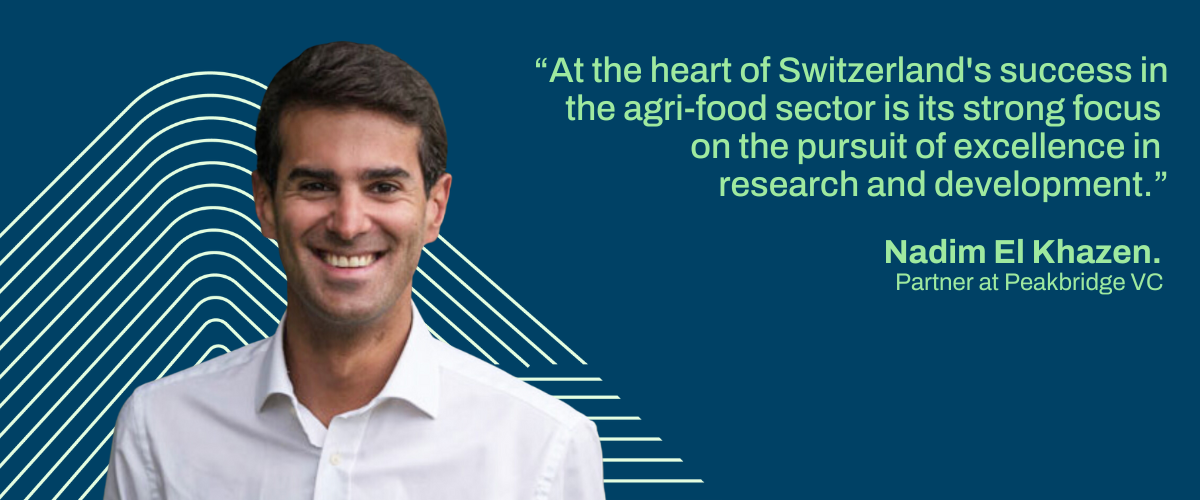
Nadim El Khazen
PeakBridge VC

As an investor, what would you say is the key factor behind Switzerland's success when it comes to agri-food innovation? 

I would say its strong focus on the pursuit of excellence in research and development. This is driven by a growing number of start-ups that have spun off from the country's leading universities, such as EPFL in Lausanne and ETH in Zurich. These academic institutions have become true breeding grounds for cutting-edge technologies that are reshaping the future of food production, from farm to fork to waste.

Swiss universities and research institutions collaborate closely with the private sector to pioneer breakthroughs in ingredients innovation, alternative proteins, digitalisation of food chains, water technology, nutrition & health and new farming systems - all of which have profound implications for the global agri-food landscape.

Could you share some examples of innovative technologies and startups in Switzerland that PeakBridge is currently focusing on and investing in?

At PeakBridge - a VC and growth investment fund - we focus on scalable proprietary B2B agri-food technologies. In the field of water technology, Swiss start-ups are developing innovative solutions to address the pressing challenges of mineral water scarcity, quality and the significant carbon footprint of single-use packaging and transportation. In fact, a company like BE WTR from Lausanne has emerged as one of the global disruptors of water distribution.

In nutrition and health, Swiss innovators are at the forefront of creating personalised and functional foods that cater to individual health needs. Through the intersection of biotechnology and nutrition, we see great innovation emerging in two segments: the first one is personalised nutrition and the influence of food on physical and mental health. The second is the use of fermentation to create new fats and proteins which can be analogs or identical to nature but always animal-free.

As food security and the re-localisation of food and water production is on top of governments agendas, Switzerland stands as one of the leading contributors to excellence and innovation in those technologies that will reshape the future of food production and consumption.

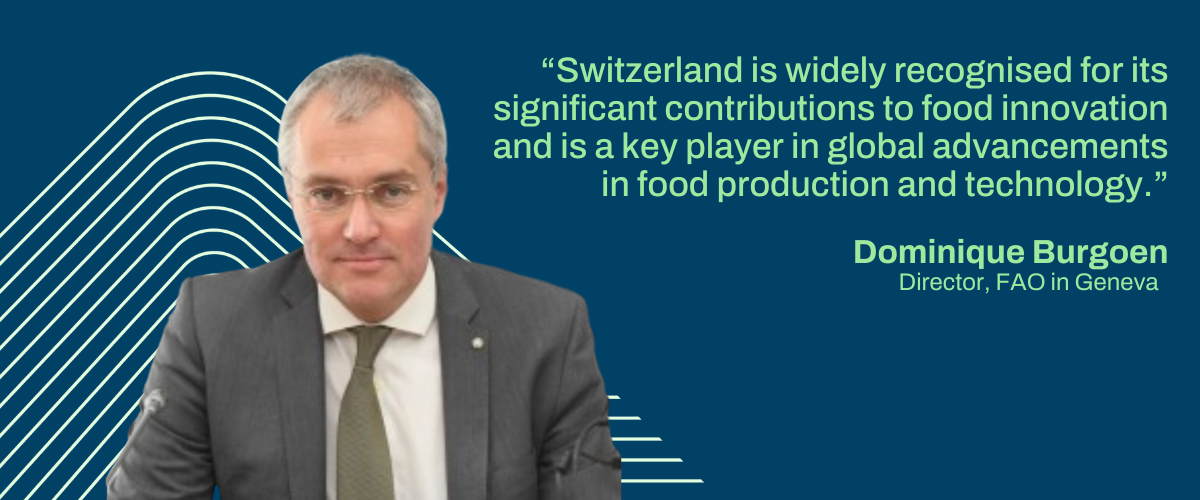
Dominique Burgeon
FAO Office in Geneva

Switzerland is often regarded as a leader in food innovation. How does the FAO view Switzerland's contributions to global advancements in food production and technology?

Switzerland is widely recognized for its significant contributions to food innovation and is a key player in global advancements in food production and technology. Ranking as the fifth-largest country in terms of research and development activities and hosting major national corporations with global influence, Swiss-based companies play a crucial role in disseminating innovation and technology worldwide.

Switzerland boasts a thriving ecosystem of startups alongside multinational corporations and benefits from its leading technical universities and come up with solutions which could address several challenges regarding food, nutrition, and production in the future. The government actively supports and encourages this innovative environment.

Finally, we've also observed a strong emphasis on research and development related to water. Many Swiss companies are leading innovations in clean drinking water, sanitation, and irrigation. These advancements don't only benefit Switzerland but also have the potential to make a substantial impact in developing countries, ensuring access to clean water and enhancing water productivity in agriculture.

What specific initiatives or programs has the FAO collaborated on with Switzerland to promote sustainable agriculture and food innovation, both within the country and internationally?

FAO has engaged in several important collaborations with Switzerland to advance sustainable agriculture and food innovation, both domestically and internationally. There are, for example, Memoranda of Understanding (MoUs) with Swiss companies and associations aimed at enhancing the transformation of agrifood systems within the private sector. One noteworthy collaboration is with the Kuehne Foundation, which has provided crucial logistical support, knowledge transfer, and training for various agricultural initiatives. This support extends to field operations and logistics management in challenging environments. FAO also has an agreement with SIPPO, the Swiss Import Promotion Programme, to integrate developing and transition countries into world trade.

FAO is now looking to intensify its collaboration with the Swiss private sector to bolster sustainable agriculture and food innovation initiatives. FAO Members have developed a new private sector engagement strategy and, in line with this commitment, Deputy Director-General Beth Bechdol met with private sector representatives earlier this year. We now have a dedicated private sector expert at the FAO Liaison Office in Geneva to facilitate and strengthen ongoing engagement with the private sector, ensuring that these partnerships continue to evolve and contribute effectively to our work around sustainable agriculture and food innovation. And of course, the FAO also cooperates very closely with the Swiss government, both to strengthen relations with the Swiss business sector, as well as in many other programmatic areas.

What role do you see the Swiss private sector playing in supporting the FAO to achieve its objectives?

We see the Swiss private sector potentially playing a multifaceted and vital role in supporting FAO in achieving its objectives across the agrifood system. One key area of collaboration is in nutrition, where several Swiss companies are actively developing solutions to enhance the nutritional content of food, particularly for vulnerable populations. Many companies are also pioneering other initiatives to contribute to more balanced and sustainable diets by, for example, developing plant-based meat alternatives.

When it comes to technology, Swiss businesses contribute to soil preservation and improved agricultural practices through, for example, advanced technologies in soil mapping. This facilitates precision agriculture and more efficient water management. We see this work complementing FAO’s capabilities in geospatial data and in-country resources and aim to foster productive partnerships between Swiss initiatives, FAO and its Members to deliver our shared development objectives.

Switzerland is also home to numerous multinational corporations that play a crucial role in global food production and distribution. For instance, some companies excel in optimising food packaging, particularly for beverages, ensuring product quality and food safety, which aligns with FAO's efforts to enhance food preservation and quality while minimising contamination risks.

Lastly, Switzerland is a major hub for coffee trade. Approximately 50 percent of the world's coffee trade flows through Switzerland, and a thriving manufacturing industry makes Switzerland one of the top five coffee exporters globally for finished products by value. This fact alone has far-reaching implications as Swiss companies are essential partners for coffee growers in developing countries. Several players in the coffee value chain are vocal about their commitment to sustainable and equitable value chains, which underscores the importance of stable production and sustainability for the future.

The Swiss private sector's diverse contributions to agrifood systems transformation present abundant opportunities for continued collaboration - and we look forward to working alongside with the Valley team and industry partners to make this happen.

Never miss a Swiss food innovation morsel.