Pasta Premium launches cook-stable pasta without egg white using EggField Aquafaba

Pasta Premium launches cook-stable pasta without egg white using EggField Aquafaba

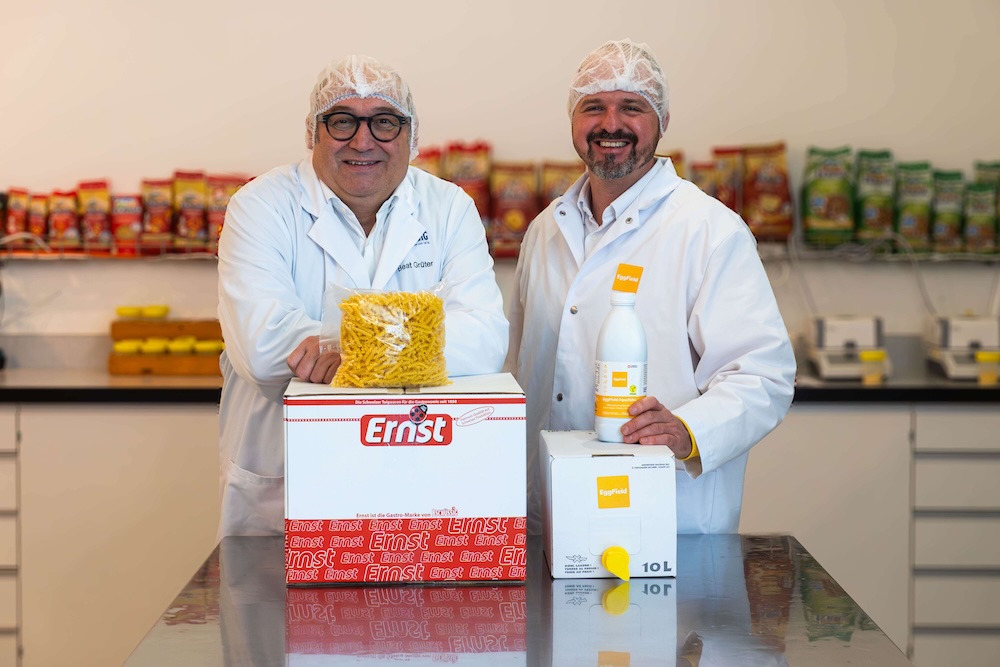
In collaboration with EggField, Pasta Premium is launching a new generation of cook-stable, plant-based pasta. The products will be introduced under the ERNST brand and combine the firm bite of traditional pasta with a fully plant-based formulation. They have been specifically developed for use in gastronomy, catering, and food service.

The new ERNST pasta is based on durum wheat semolina and aquafaba (legume cooking water), a by-product of legume processing. It replaces key functionalities of egg, enabling pasta with a stable structure and high cooking, holding, and regeneration performance—critical for professional kitchen environments. With this development, Pasta Premium also responds to volatile egg availability while offering a resource-efficient and long-term stable alternative.

“Our legume-based ingredient delivers the functionality of egg—without compromising on sensory quality. The collaboration with Pasta Premium shows that even in pasta applications, sustainable, scalable, and high-performing solutions are possible,” says Silvan Leibacher, CEO and co-founder of EggField. For ERNST pasta, the focus was not only on product quality but also on real-world applicability.

“What mattered most was a solution that works in everyday professional kitchens and is future-proof,” says Sarah Anderhub, Head of Marketing at ERNST pasta. “The new products allow our customers to simplify their assortment, respond flexibly to different dietary needs, and consistently deliver high quality. At the same time, they rely on an innovative Swiss product with a compelling price-performance ratio—both from a quality and economic perspective.”

Traditional egg-based recipes are not being replaced; rather, EggField enables, for the first time, the production of cook-stable pasta without the addition of egg white. For food service operators, this simplifies both offerings and processes: the pasta serves as a single solution across different dietary requirements—from conventional to plant-based. In addition, removing egg as an allergen simplifies labeling, procurement, and storage—without requiring changes in kitchen processes or recipes.

Sign up for quarterly Swiss food innovation updates.

Cosaic secures $6 million seed extension as industry leaders back next-generation food ingredients

Cosaic secures $6 million seed extension as industry leaders back next-generation food ingredients

Cosaic, the Swiss food biotech startup developing yeast-derived multifunctional ingredients, today announced a $6 million round. The round includes participation from dsm-firmenich Ventures, the venture arm of dsm-firmenich, a global leader in Health, Nutrition and Beauty. Also joining the round are a large Swiss family office and Kickfund, a Swiss deeptech investor,  as well as existing investors such as Navus Ventures and Zuercher Kantonalbank. In a tougher funding environment, this round shows that investors continue to support foodtech companies when the technology is distinctive and the commercialization plan is realistic.

Cosaic is developing a new category of food ingredients based on yeast fermentation. Its platform is designed to help food and beverage manufacturers deliver creaminess, stability and functionality in a single ingredient, addressing formulation challenges that have traditionally required multiple components and additives. This investment signals growing industry interest in ingredient platforms that move beyond one-to-one replacement narratives and instead offer measurable functional value to manufacturers.

The round will support three priorities over the coming phase of growth to become market ready: regulatory work, production scale-up, and industrial trials with large clients.

“This round sends a clear signal: the market is backing foodtech companies that can deliver real functional value and a credible path to commercialization,” said Tomas Turner, co-founder and CEO of Cosaic. “At Cosaic, we are building an ingredient that resolves the trade-offs food companies face every day between clean label, sensory performance, and cost. With strong strategic backing and a capital-efficient scale-up model, we are well positioned to move from development to launch readiness.”

The announcement follows Cosaic’s strategic go-to-market partnership with another leading ingredient house, Ingredion, announced in late 2025, which provided the company with important commercial validation. With backing from Ingredion and dsm-firmenich Ventures, Cosaic is now accelerating the path from product development to market launch.

About Cosaic (formerly known as Cultivated Biosciences)

Cosaic is a Swiss biotech and foodtech startup that aims for a world in which good food choices benefit everyone: people, businesses, and the planet. They do this with ingredient solutions that offer greater industry resilience and greater consumer satisfaction. Cosaic Neo is their first ingredient, a unique natural multifunctional emulsion that delivers perfect stability and delicious creaminess, all at once, by itself. It is a patented food ingredient born from yeast fermentation. Its complex microstructure allows for multiple functionalities to reconcile product performance with sensory experience while cleaning labels. Cosaic employs 15 people and is in pre-series A stage, preparing for a market entry next year in the US. More info: www.cosaic.bio

Sign up for quarterly Swiss food innovation updates.

Swiss student innovators took the stage at Ecotrophelia Switzerland 2026

Swiss student innovators took the stage at Ecotrophelia Switzerland 2026

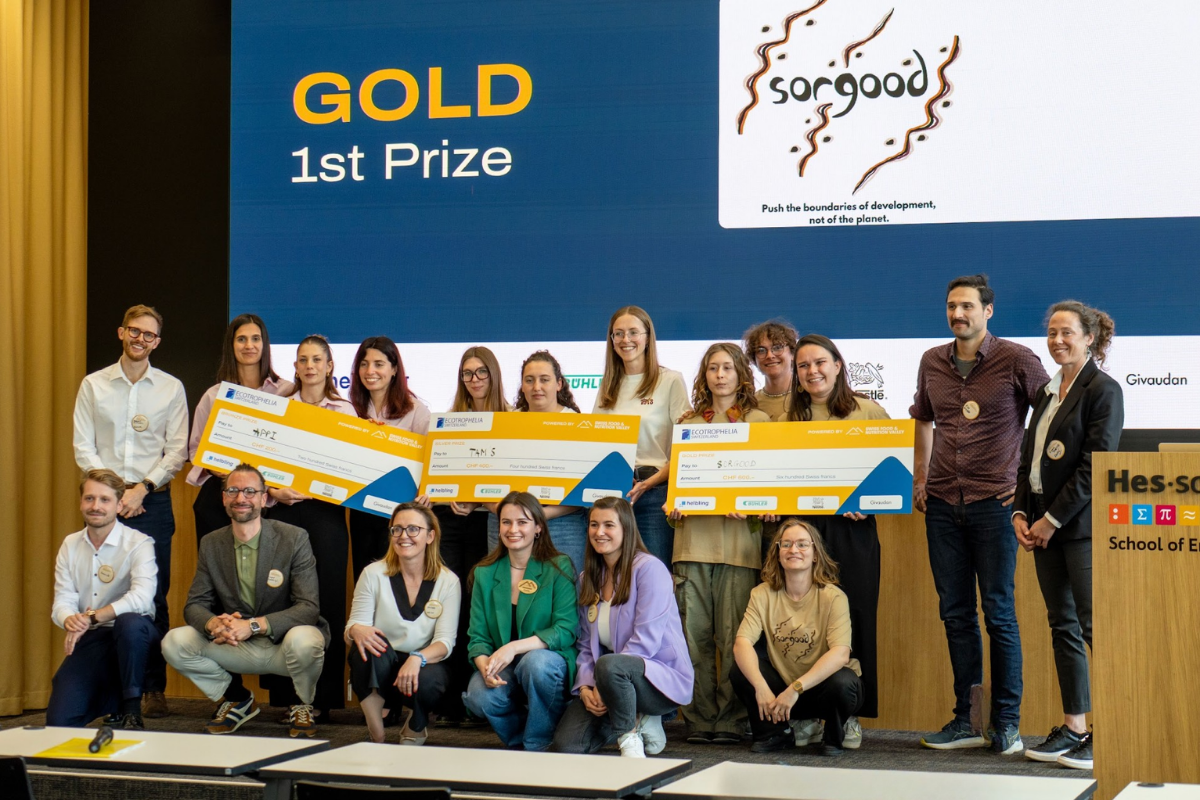
Ecotrophelia Switzerland 2026 brought together some of the country’s most promising student innovators, as multidisciplinary teams from Swiss universities presented sustainable, market-ready food products to an expert jury of industry and academic leaders.

Part of a wider European initiative, the competition challenges students to translate scientific knowledge into commercially viable solutions, combining creativity, technical expertise and entrepreneurial thinking. This year’s edition once again highlighted the strength of Switzerland’s talent pipeline in food innovation.

“Ecotrophelia is a unique platform where students can apply their knowledge to real-world challenges in the food system,” said Sandra Galle, Professor of Food Technology and Biotechnology at HES-SO, School of Engineering in Sion. “It not only fosters innovation, but also helps build the skills and confidence needed to bring new ideas to market.”

This year’s finalists

Three teams were selected to compete in this year’s final, each showcasing a different approach to sustainable food innovation:

  • Team Appy developed an apple juice drink with functional apple pomace pearls.
  • Team Sorgood created a fermented beverage based on sorghum for a more resilient food system.
  • Team TAMs developed a high-fiber  Provençale snack made of low-glycemic index ingredients and by-products.

Sorgood is crowded the national winner

The jury awarded first place to Sorgood, recognising the product’s innovation, sustainability impact, and market potential. 

The winning team stood out with an innovative plant-based beverage made from sorghum, a resilient and underutilised climate-smart crop. Their solution highlights how traditional grains can inspire sustainable, nutritious alternatives in the plant-based beverage category. 

An industry perspective

This year’s national competition was made possible thanks to the generous support of Valley partners Helbling Technik, Nestlé, Bühler Group and Givaudan.

Reflecting on the competition, Lorenz Klauser, Senior Vice President and Partner at Helbling Technik, noted: “Ecotrophelia shows how innovation starts with people. Sharing our experience in bringing products to life and our broad technical expertise with these talented teams has been truly rewarding. It highlights how young talent can drive real change in the food system.”

From the jury’s perspective, Robert Mitchell, Head of Food Science at Bühler, added: “It’s impressive how quickly students developed solid concepts. Competitions like Ecotrophelia help prepare the next generation to tackle real-world challenges in scaling affordable, nutritious food. Congratulations to all the teams.”

At Nestlé R&D, the importance of nurturing entrepreneurial talent was front of mind. As Maria Eugenia Barcos, Nestlé Research Startup Program Lead, put it: “At Nestlé R&D, we believe that supporting young talents with an entrepreneurial spirit is essential to accelerating the transformation of sustainable food systems. It’s been impressive to see how the students naturally take into account the importance of collaboration, sustainability and market readiness.”

Highlighting the role of sensory experience and creativity in food innovation, Matthias Schultz, Research Director at Givaudan International SA, said: “Watching the young talents at Ecotrophelia bring their bold ideas to life was truly inspiring. Their entrepreneurial drive and creativity turned ideas into tangible food experiences , a vision that resonates deeply with Givaudan’s purpose of creating happier, healthier lives with love for nature. ”

What comes next

The journey continues beyond the competition. In the coming months, participating teams will continue to be supported by industry partners, including Nestlé, Helbling Technik, Bühler and Givaudan, helping them further refine their concepts and explore pathways to market.

The winning team will go on to represent Switzerland at Ecotrophelia Europe, one of Europe’s leading student competitions in food innovation, taking place at SIAL Paris later this year.

Sign up for quarterly Swiss food innovation updates.

planetary raises ~$28 million (CHF 22 million) in funding to scale global fermentation infrastructure and licensing platform

planetary raises ~$28 million (CHF 22 million) in funding to scale global fermentation infrastructure and licensing platform

Planetary SA (“planetary” or the “Company”), the Swiss-based full-stack fermentation company building the industrial backbone of the bioeconomy, today announced a ~USD 20 million (CHF 16 million) Series A equity financing round, supplemented by ~USD 7.5m (CHF 6 million) in credit, bringing total funding to approximately ~USD 40 million (CHF 32 million).

The round was led by Radikal Capital and Oetker Ventures, with participation from, amongst others, Royal Cosun (as previously announced), arc investors, Green Generation Fund and AgriFoodTech Venture Alliance, as well as existing investors Astanor Ventures and XAnge. This diverse syndicate (bringing together carbohydrates producers, food corporates, venture capital funds, and family offices) reflects broad confidence in planetary’s full-stack approach and support for its global ingredient commercial rollout and technology licensing strategy.

The strong interest in the round underscores a clear market shift: category leaders controlling the full value chain from process development and industrial infrastructure to product launch are emerging as the winners of the new food revolution.

On the closing this round, David Brandes, CEO and co-founder of planetary added: “Raising capital outside AI and defense now requires far more focus and resilience than it did just a few years ago. Yet, recent geopolitical turmoil and commodity volatility only strengthen the case for a sovereign, circular, and high-quality food system: stay the course and hold the line, nothing worth building comes easy.”

planetary operates a proprietary full-stack platform spanning bioprocess design, scale-up and industrial manufacturing via its WIPO GREEN listed BioBlocks™ system, enabling partners to bring fermentation-based food ingredients to market efficiently.

At the core of its IP-rich strategy sits the global licensing of its technology to agro-industrial players, particularly sugar companies, enabling the conversion of low-value side streams into high-value proteins, fibers and enzymes, unlocking a new circular bioeconomy.

The company has demonstrated strong commercial traction. Following the nationwide launch of its mycoprotein filet with ALDI Suisse at price parity, the company is now rolling out additional launches across Europe under its B2B brand Libre® across alternative meat and dairy, meat hybrid products, fiber-rich products and protein fortification applications.

planetary is also expanding its sugar-to-protein upcycling technology globally, including initiatives to enable ultra-low-cost mycoprotein production below $1/kg through partnerships with agro-industrial players in sucrose-rich and protein-deficient geographies, such as India.

With industrial-scale production already operational in Aarberg, Switzerland and a growing pipeline of licensing partnerships, planetary is positioning itself as a central technology layer for the fermentation economy.

The company welcomes discussions with engineers, commercial leaders and product innovators interested in joining a category-defining company, as well as with customers seeking to co-develop the next-generation food products. planetary will selectively engage with mission-aligned investors interested in participating in a second closing of the round, planned for later this summer.

Sign up for quarterly Swiss food innovation updates.

World Food Academy 4 Sustainable Food Systems founded for knowledge sharing and capacity building

World Food Academy 4 Sustainable Food Systems founded for knowledge sharing and capacity building

Nestlé and The United Nations University Institute for Water, Environment and Health (UNU-INWEH) have entered into a strategic partnership to establish the World Food Academy 4 Sustainable Food Systems.

Envisioned as a multi-partner ecosystem, the Academy will strengthen education, career development and knowledge exchange for university students, early career researchers, and young professionals working in food and nutrition research and production, particularly those from priority regions in the Global South.

Prof. Kaveh Madani, Director of UNU-INWEH stated: “The World Food Academy represents a platform to translate interdisciplinary research into actionable solutions by equipping emerging leaders, particularly in the Global South, with the scientific, technical, and policy competencies required to address systemic challenges in food security, nutrition, and sustainability. This collaboration with Nestlé further strengthens our ability to bridge science and policy, ensuring that knowledge is effectively translated into practice while advancing sustainable and resilient food systems for future generations.”

The World Food Academy will incorporate Nestlé’s existing Science & Technology Seminars, a key initiative under Nestlé needs YOUth. First launched in 2023, the free, expert-led seminars cover topics such as agricultural science, food science and technology, as well as nutritional science. They also offer technical expertise related to affordable and sustainable food production. Initially offered through partner universities, the Nestlé seminars reached around 7 000 students across over 300 academic institutions in more than 90 countries last year.

UNU-INWEH will contribute its expertise in research, capacity building, policy engagement, and knowledge dissemination to support the seminars. This will help to ensure that participants receive up-to-date knowledge, practical insights and tools to support their professional development. It will also share its knowledge related to sustainable agriculture and responsible land management which are vital for food security, biodiversity, and climate resilience. The initiative complements UNU-INWEH‘s broader efforts in online education through the Online Learning Centre, the Media Academy, and the UN Water Conference Academic Hub, while further strengthening capacities built over the Institute’s 30 years. All activities will align with the United Nations Sustainable Development Goals (SDGs), in particular on advancing quality education and reducing inequalities.

Educational resources developed through this partnership will remain publicly accessible at no cost, ensuring free access for learners worldwide, particularly those in low-income regions.

Professor Stefan Palzer, Chief Technology Officer at Nestlé, said: “Ensuring global food security and driving the transition to sustainable food systems requires intense collaboration along the food value chain. Through this joint initiative with the United Nations University, we will share our broad and deep scientific expertise, along with our practical knowledge of food and nutrition, with underprivileged students and young professionals around the world. This know-how will enable them to more effectively transform both global and local food systems, making food more nutritious, accessible and sustainable.”

Both partners will explore opportunities to expand the Academy’s scope over time. This includes by building a global network of educational institutions, industry partners, and research organizations, while offering career development opportunities, specialized capacity development programs, sabbaticals, internships, and fellowships.

Later this year, UNU-INWEH and Nestlé will jointly host a symposium on Sustainable Food Systems. The event will bring together policymakers, researchers, private sector representatives, and civil society to explore practical solutions for improving access to nutritious, affordable food while supporting sustainable agricultural practices.

To learn more visit the World Food Academy website.

Sign up for quarterly Swiss food innovation updates.

BIOKET 2026: Fribourg Shines on the International Bioeconomy Stage

BIOKET 2026: Fribourg Shines on the International Bioeconomy Stage

For the first time in Switzerland, Fribourg hosted the international BIOKET congress, dedicated to key enabling technologies in the bioeconomy. Over three days, 485 experts from around 30 countries gathered to explore solutions for more sustainable production models. This edition reinforces the canton’s position as a credible and well-connected player on the global stage.

The seventh edition of BIOKET took place from March 17 to 19, 2026, at Forum Fribourg and closed on a highly positive note. Over three days, 485 participants from around 30 countries turned Fribourg into an international hub for key enabling technologies in the bioeconomy. Organised by the Bioeconomy For Change (B4C) cluster, in partnership with the Fribourg Development Agency (FDA), BIOKET featured a dynamic programme of conferences, technical sessions, B2B meetings, workshops and site visits. Around fifty exhibitors and partners also showcased their solutions, providing hands-on insight into ongoing initiatives.

“This edition in Fribourg truly captures the spirit of BIOKET: building bridges between research, industry and regions. We found here a particularly supportive environment, well suited to accelerating collaborative projects,” said Johan De Coninck, Head of Connexions & International at B4C.

A Key Driver in Transforming Production Models

At the heart of the discussions was the bioeconomy – encompassing all activities that use biological resources to produce food, materials, molecules, biopolymers and energy. Sitting at the intersection of industry, research and innovation, it plays a central role in the transition towards a more circular economy.

Recent developments in the Middle East have once again highlighted how dependent our economies remain on fossil resources. In this context, the bioeconomy offers tangible alternatives to reduce this dependence and strengthen the resilience of value chains.

Showcasing Fribourg’s Ecosystem

Beyond the conference programme, BIOKET 2026 offered participants a first-hand look at Fribourg’s ecosystem through visits to key sites: the Liebherr Group and its technologies, particularly in hydrogen engines; the AgriCo campus, dedicated to agri-food innovation and biomass valorisation; and the innovation ecosystem bringing together bluefactory, the ChemTech institute of the School of Engineering and Architecture of Fribourg, and the Marly Innovation Center. These visits highlighted the canton’s ability to cover the entire value chain, from applied research to industrialisation.

“BIOKET 2026 shows that Fribourg is a place where ideas become concrete solutions. The bioeconomy is no longer just a promise or a potential – it is a fast-growing industrial reality in our canton, as illustrated by start-ups such as Bloom Biorenewables and Seprify. The latter has recently raised more than 12 million Swiss francs,” said Jerry Krattiger, Director of the FDA

A Clear, Long-Term Strategy

Hosting BIOKET 2026 is part of the canton’s enomic development strategy, which identifies the bioeconomy – alongside Industry 4.0 – as a key priority. Following the Bioeconomy Forum in 2024, this international edition marks a new step forward and confirms Fribourg’s strong positioning within European and global bioeconomy networks.

Sign up for quarterly Swiss food innovation updates.