What the food industry can learn from GDI’s Major Shifts model

What the food industry can learn from GDI’s Major Shifts model

The Future of Food: Givaudan, Nestlé R+D Accelerator Lausanne and FoodHack launch the 2025 FoodTech World Cup

The future is coming faster than many companies can keep pace with. This is especially true for actors in the food industry, as developments in STEM and climate change continue at speed. And nobody knows that better than the Gottlieb Duttweiler Institute (GDI). This is why GDI launched a report delving deeper into their latest foresight model – GDI Major Shifts. 

In the world of food, understanding major global developments and interpreting plausible scenarios is vital for future planning and decision-making. That’s where the GDI’s latest report on their ‘Major Shifts’ model – which combines data-based analysis and interpretations to predict plausible future outcomes – comes in particularly useful. Identifying and explaining dynamic developments across sectors, the team at Switzerland’s oldest think tank shared a taste of what the food industry can learn from their analysis. 

GDI Major Shifts: An Overview

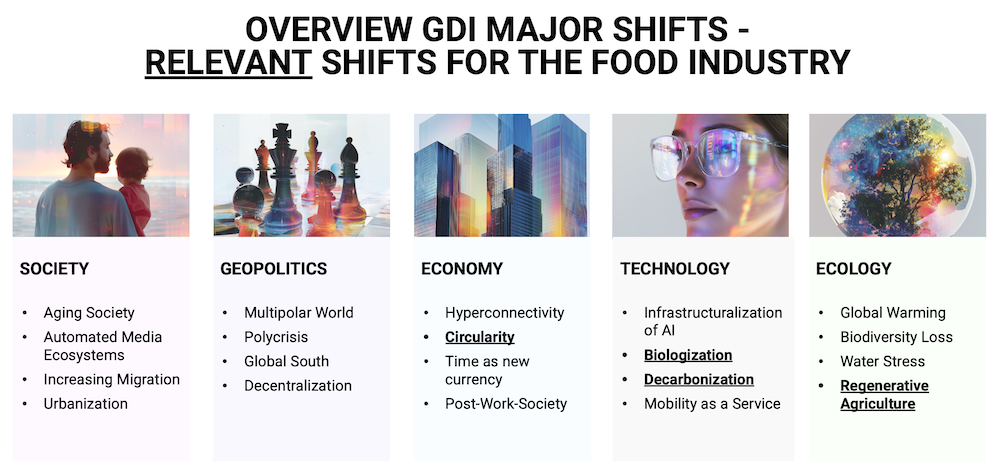
The GDI team identified 20 key shifts in five categories – society, technology, economy, environment and politics – and analysed their life cycles. The implications identified provide companies with precise and realistic indicators for successful long-term planning and alignment with future trends – as well as identifying business areas that will no longer be relevant.

    Four key areas among the twenty major shifts have particular relevance for the food industry.

    Circularity

    The shift towards circularity is fundamentally changing the food sector. Circularity – closing resource loops and minimizing waste – has become a key driver of innovation and competitiveness:

    • Waste as a resource: Companies are transforming food by-products into new ingredients and products, reducing landfill and creating added value.
    • Regenerative supply chains: Circular models prioritize regenerative agriculture, compostable packaging, and reusable systems, restoring ecosystems and reducing environmental impact.
    • New business models: The demand for zero-waste and circular solutions is fueling innovations such as upcycled foods, refill systems, and digital platforms for food redistribution.

    Biologisation

    Biologisation marks the transition from mechanical and industrial approaches to biological and organic solutions. In the food sector, this means a shift toward:

    • Bio-based ingredients and production: Expect a surge in foods produced using fermentation, cultured cells, or engineered microorganisms. These technologies promise more sustainable, resource-efficient alternatives to traditional agriculture.
    • Convergence of biology and technology: The integration of biotech, data science, and engineering will enable personalized nutrition, precision fermentation, and new functional foods tailored to individual health profiles.
    • Sustainability as a core driver: As the demand for climate-friendly, ethically produced food grows, companies that embrace biotechnological innovation will set new industry standards and capture emerging markets.

    Decarbonisation

    The pressure on the food sector to reduce its CO₂ footprint is increasing rapidly.

    • Decarbonisation – the transition from fossil fuels to renewable, carbon-free energy sources – is becoming a key competitive factor:
    • Climate-neutral production: Food manufacturers are investing in renewable energy, electrifying processes, and adopting low-carbon logistics to reduce emissions along the entire value chain.
    • Transparency and reporting: More and more consumers and business partners are demanding proof of the climate impact of products. Companies that transparently disclose and reduce their emissions strengthen their market position.
    • New business models: The demand for climate-friendly products is creating space for innovation – from CO₂-neutral brands to climate-conscious gastronomy and sustainable delivery services.

    Regenerative agriculture

    Regenerative agriculture is moving from a niche concept to a mainstream imperative. Its impact on the food industry includes:

    • Supply chain transformation: Food companies are increasingly investing in regenerative practices that restore soil health, boost biodiversity, and sequester carbon. This not only mitigates environmental impact but also addresses growing consumer demand for transparency and sustainability.
    • Shorter, more transparent value chains: Regenerative models favor local sourcing, traceability, and direct relationships between producers and consumers, challenging the dominance of globalized, opaque supply chains.
    • Competitive advantages through ecosystem stewardship: Brands that adopt regenerative principles are poised to lead, as regulatory pressure and investor expectations around sustainability intensify.

    The main takeaway?

    The companies who invest now in biotechnology, regenerative systems, circularity and decarbonisation – which analysis shows are heavily interlinked – will secure a pole position in the food market of the future. The next food revolution will be organic, regenerative and circular.

    Eager to dive deeper? Contact Susan Shaw, Head of Strategic Foresight at GDI.

    About the Gottlieb Duttweiler Institute (GDI)

    The Gottlieb Duttweiler Institute (GDI) is Switzerland’s oldest think-tank. A place of inspiration and innovation where strategic visions are expounded, the GDI provides a forum for key decision-makers to shape the future of the economy and society. The GDI unites research and industry-relevant applications to define path-breaking strategies in tandem with business. This institute, which operates independently, is supported by the Migros Culture Percentage.

    gdi.ch

    Sign up for quarterly Swiss food innovation updates.

    Meet the finalists of the Igeho Rising Star Award for 2025 

    Meet the finalists of the Igeho Rising Star Award for 2025 

    The Future of Food: Givaudan, Nestlé R+D Accelerator Lausanne and FoodHack launch the 2025 FoodTech World Cup

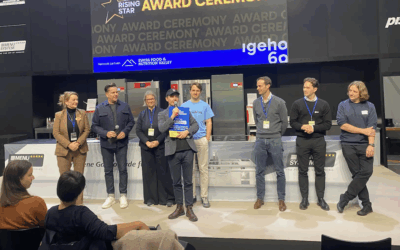
    Many startups applied. 15 made it to the public vote. Now just five remain. The 2025 Igeho Rising Star Award is designed to provide emerging companies in hospitality with an opportunity to showcase their businesses, raise awareness of their innovations, and connect with industry professionals.

    As Switzerland’s leading international hospitality industry platform, Igeho aims to use this award to drive innovation by offering startups a platform and networking opportunities, in collaboration with Swiss Food and Nutrition Valley. 

    So who are the lucky five finalists? We sat down with them all to find out what sets them apart and why they think they deserve to be crowned winners of the 2025 Igeho Rising Star Award.

    🐟 Catchfree – Plant-based seafood alternatives

    What we do:
    Catchfree reimagines seafood – without the fish. We craft plant-based alternatives that deliver the taste and texture of the ocean, without harming marine ecosystems.

    Why we deserve to win:
    We’re not just offering another alt-protein – we’re tackling one of the most unsustainable sectors in food. Winning this award would spotlight innovation that protects our oceans and supports a more resilient food system.

    ♻️ Circunis – Digital marketplace for surplus food

    What we do:
    Circunis is a smart B2B platform that connects businesses with surplus food to buyers who can use it — turning waste into value through real-time, traceable transactions.

    Why we deserve to win:
    Food waste is a trillion-dollar problem, and we’re solving it with tech that’s easy to adopt and scale. This award would amplify a solution that’s good for both the planet and the bottom line.

    🌾 Foodflows – Authentic farm-to-table sourcing with Brazilian growers

    What we do:
    Foodflows improves how chefs and restaurants source foods from abroad — making supply chains shorter, fresher, and fairer through a collective and innovative platform.

    Why we deserve to win:
    We’re bringing transparency and trust back into food sourcing and onto menus, addressing the root cause rather than the symptoms of our food system’s issues.

    🤖 GoNina – AI-driven forecasting for food businesses

    What we do:
    GoNina uses AI to predict demand in food businesses like bakeries — helping them order smarter, prep efficiently, and reduce food waste without compromising their core offering.

    Why we deserve to win:
    We help food businesses thrive in an unpredictable world. With rising costs and high waste, our tech empowers businesses to stay ahead — and that’s the kind of innovation the food sector needs.

    🍄 Yumame Foods – Innovative fungi-based food products

    What we do:
    Yumame harnesses the power of fungi to create delicious, nutritious, and sustainable food — offering a new generation of minimally processed, plant-based products without compromise. 

    Why we deserve to win:
    We’re not following trends — we’re setting them. Our fermentation-based approach unlocks scalable, tasty, and nutrient-rich plant-based food that can transform how we eat.

    Pitching to an expert jury

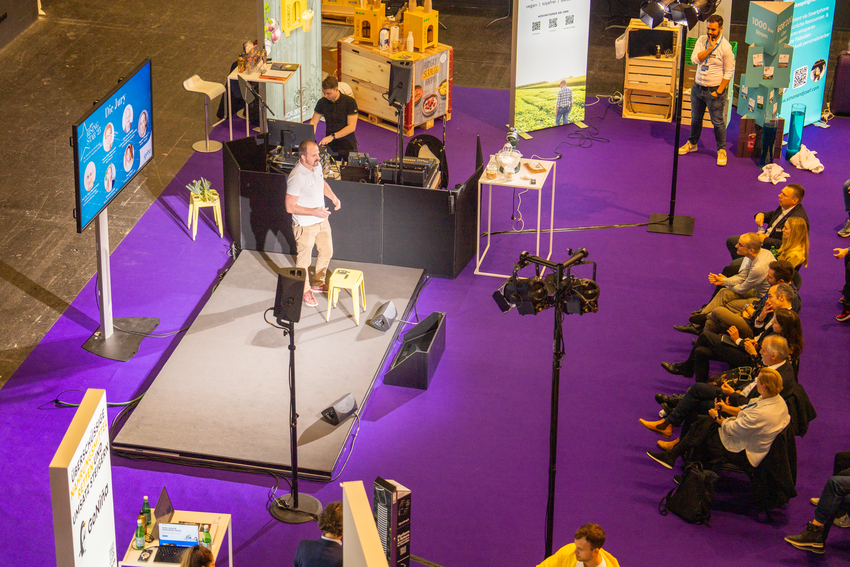
    All finalists will present their solutions on the Igeho 2025 stage on November 18, and answer questions from a jury composed of Swiss leaders in the field.

    • Pascal Bieri, Co-Founder of Planted
    • Dr Claus-Heinrich Daub, Professor of Sustainable Business Management at FHNW
    • Marina Helm Romaneschi, Marketing & Innovation Strategy at Swiss Food Research
    • Christine Schäfer, Senior Researcher at the Gottlieb Duttweiler Institute. 
    • Rebecca Clopath, an Alpine natural chef
    • Christian Gerber, Head of Innovation Management at ZFV.

    All 15 start-ups that participated in the public voting for the Rising Star Award will have the opportunity to showcase their innovations to the Swiss hospitality audience over two days at Igeho 2025 in Basel. In addition to the five finalists, the following start-ups will also be exhibiting at the trade fair: Actidot, FoodFor, Hexafed, LOVYÜ, Niatsu, Sanvitafood, Saya Suka, SwissMiso, and TrueFoods.

    www.igeho.ch 

    Sign up for quarterly Swiss food innovation updates.

    Nestlé and IBM leverage AI and deep tech to unlock new packaging innovations

    Nestlé and IBM leverage AI and deep tech to unlock new packaging innovations

    The Future of Food: Givaudan, Nestlé R+D Accelerator Lausanne and FoodHack launch the 2025 FoodTech World Cup
    Valley partner, Nestlé R&D has teamed up with IBM Research to develop new tools that leverage the power of Artificial Intelligence and deep tech to bring breakthrough innovations to life. This research collaboration has led to the development of a generative AI tool that can identify novel high-barrier packaging materials.
    Why Packaging Innovation Matters

    Packaging helps to protect food and beverages while also preventing food waste. Nestlé is continuously reducing the use of virgin plastic, pioneering the use alternative materials and novel technologies, and moving to recyclable mono-material and paper-based solutions. Identifying new packaging materials that meet each product’s functional needs while ensuring food safety and quality is often meticulous. In some cases, this requires years of research.

    Nestlé and IBM scientists leveraged AI-based processing techniques1 to construct a knowledge base of known materials from public and proprietary documents. Subsequently, the team fine-tuned a fit-for-purpose chemical language model on this curated corpus, enabling it to learn the representation of the molecular structures. Using that knowledge, the teams leveraged the recently developed regression transformer2 by IBM Research to learn the correlation between key structural molecular features and the resulting physical-chemical properties. The resulting model can now propose entirely new high-barrier packaging materials that shield sensitive products from moisture, temperature swings and oxygen.

    Identifying future packaging materials

    Nestlé will utilize this novel technology to identify future packaging materials, while considering cost, recyclability, and functionality.

    Stefan Palzer, Nestlé Chief Technology Officer: “This novel AI-powered language model, developed in collaboration with IBM Research, illustrates how Nestlé is leading the digital transformation within the food and beverage industry. In the future, such breakthrough technology could be used to optimize the development of more sustainable packaging solutions across product categories.”

    Alessandro Curioni, IBM Research VP Europe & Africa: “We do believe that Generative AI will continue to disrupt scientific discovery, impacting the core business of all knowledge-based industries, allowing critical differentiation and sustainable growth.”

    Beyond Packaging: AI Across Nestlé’s Operations

    Nestlé continues to leverage AI, machine learning, data science and automation to support innovation and help manage complexities. For example, Nestlé has developed a recipe optimization tool that uses advanced algorithms to help product developers better manage tradeoffs between ingredients, nutrition, cost and sustainability, while still meeting consumer expectations. The company also uses digital twins of equipment and production lines to optimize manufacturing processes and has developed digital tools to deliver personalized nutrition solutions for people and pets.

    Nestlé recently announced the creation of a new R&D center for deep tech, a first-of-its-kind in the food and nutrition industry. The new center will screen, test and develop new generations of sensors, robots, coding systems, high-performing AI and virtual/mixed reality solutions to increase efficiency in research, innovation and operations.

    Never miss a Swiss food innovation morsel.

    GoNina secures new funding from the Migros Pioneer Fund in its mission to reduce food waste

    GoNina secures new funding from the Migros Pioneer Fund in its mission to reduce food waste

    The Future of Food: Givaudan, Nestlé R+D Accelerator Lausanne and FoodHack launch the 2025 FoodTech World Cup

    Swiss foodtech startup GoNina has secured support from the Migros Pioneer Fund, marking a major new milestone in its mission to reduce food waste in Switzerland. Thanks to this partnership, GoNina will be able to further develop its AI-powered forecasting solution and expand into new cities.

    The latest collaboration with the Migros Pioneer Fund paves the way for smarter and more sustainable food systems across Switzerland – powered by local businesses and cutting-edge technology.

    At the heart of GoNina is a powerful, AI-driven forecasting tool. This model helps businesses – from independent cafés and bakeries to restaurants and national chains – predict daily demand with amazing precision and adjust production accordingly.

    Smarter forecasting, less waste

    By combining real-time data, location-specific variables, and internal company insights, GoNina helps to prevent overproduction before it happens – thereby reducing food waste at the source.

    Now with the backing of the Migros Pioneer Fund, GoNina is accelerating the development and rollout of this technology, making it easier for food businesses of all sizes to operate more efficiently and sustainably.

    Turning surplus into opportunity

    Of course, not all surplus can be avoided. That’s where GoNina’s alternative solution comes in: through the GoNina app, leftover meals are offered as heavily discounted ‘lucky dip’ bags and are available for nearby consumers to collect.

    The demand is clearly there: in the past 12 months, the GoNina app has seen 13,000 app downloads, with 1 in 10 users from Bern, despite the fact that the app has not officially launched in the region yet.

    With the new funding, GoNina will officially go online in Bern – in partnership with well-known businesses like Bakery Bakery, TINYFISH, and Bonne Maman. Over the coming months, the company plans to grow this network of local partners – both in Bern and beyond.

    Local action for a global challenge 

    Food waste is a global issue. But by addressing it locally, GoNina has found an innovative way to tackle the crisis, empowering individuals and businesses to make an impact in their own communities. With its focus on AI-powered prevention and the redistribution of surplus meals, GoNina offers a holistic solution to one of the most urgent environmental challenges of our time.

    About GoNina

    GoNina was founded in August 2023 by Ferdinand von Hagen and Matthieu Ochsner and has been publicly available since February 2024. The name is inspired by the cooling weather phenomenon La Niña and symbolizes the goal of slowing global warming – one saved meal at a time.

    Focused on the Swiss market, the GoNina platform combines AI-based demand forecasting with a flexible surplus marketplace. In its first year, GoNina attracted over 13,000 users, is active in several cantons of Switzerland, and continues to grow steadily.

    With the support of the Migros Pioneer Fund, GoNina is ready for the next big step toward a more efficient and sustainable society.

    Learn more at www.gonina.com

    About the Migros Pioneer Fund

    The Migros Pioneer Fund supports sustainable solutions to societal challenges in order to initiate systemic change toward a future-oriented society. Its impact-oriented funding approach combines financial support with active project development and risk management.

    The fund is part of the Migros Group’s social commitment and has an annual budget of around 15 million Swiss francs. It is funded by companies within the Migros Group, such as Denner, Migros Bank, Migrol, migrolino, and Ex Libris.

    Further information: www.migros-pionierfonds.ch

    Never miss a Swiss food innovation morsel.

    Bühler Scale-Up Day accelerates industry and start-up collaboration

    Bühler Scale-Up Day accelerates industry and start-up collaboration

    The Future of Food: Givaudan, Nestlé R+D Accelerator Lausanne and FoodHack launch the 2025 FoodTech World Cup

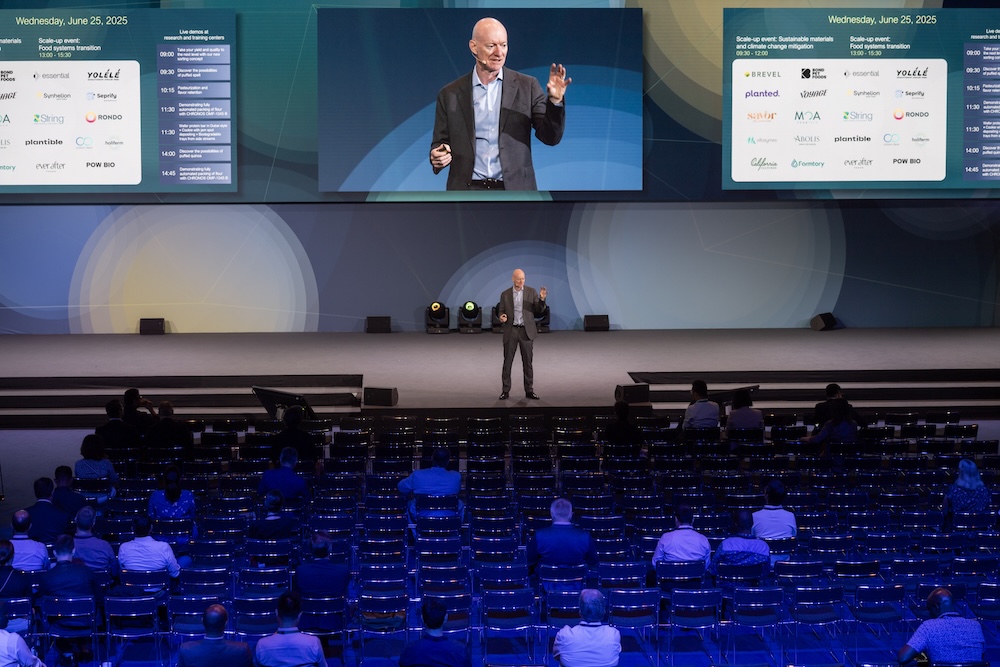
    Valley partner Bühler is making strides in bridging industrial challenges with innovation through Scale-Up Day, held during the company’s Networking Days. On June 25 in Uzwil, the Scale-Up Day brought together 21 carefully selected, high-impact scale-ups – mature start-ups with proven technologies – to connect directly with Bühler’s global customers, partners, and investors.

    With companies focused on food system transformation, climate mitigation, and sustainable materials, Scale-Up Day created a platform for building partnerships and multiplying real-world solutions. 

    “Innovation doesn’t happen in isolation. These companies are solving problems our customers face today, or will face soon,” said Thierry Duvanel, Director of Innovation at Bühler North America. “By giving them this platform, we hope to spark new partnerships, fresh ideas, and real business opportunities.”

    The aim of Scale-Up Day was to help solve real problems facing Bühler’s customers. By carefully selecting companies that address defined industry challenges in food, sustainability, and climate solutions, the event created opportunities for synergies, partnerships, and concrete action. Whether that’s joint go-to-market, deployment with customers or access to financing, this global network offers huge potential for multiplication – enabling scale-ups to grow their businesses while multiplying the impact of their solutions.

    Each scale-up had access to the decision-makers attending Networking Days, encouraging in-depth conversations and potential collaborations. “We wanted our customers to walk away with not just inspiration, but action points and real partnerships that lead to real deployment,” said Duvanel. “At the same time, the scale-ups had a unique opportunity to connect with potential multiplication partners – those who can help grow their businesses while scaling the impact of their solutions.”

    Transforming the world

    Mature start-ups selected for this year’s Scale-Up Day offer proven technologies – not just early-stage ideas. Many are already operational, funded, and scaling, with strong teams, validated solutions, and a clear industrial fit. Over a rigorous six- to eight-week selection process, Bühler collaborated with leading venture capital firms and partners – including Big Idea Ventures, SOSV, the Swiss Entrepreneur Fund, Synthesis Capital, ICOS Capital, and the MassChallenge Switzerland start-up accelerator – to identify candidates with traction, relevance, and the capacity to grow.

    “We look for big ideas which, if we can make them a reality, will completely transform the world,” said Andrew Ive, Founder of Big Idea Ventures. “We believe that working with the best start-ups and bringing them together with the best corporates allows us to scale up these technologies that are going to have a positive global impact.”

    The selection process resulted in a curated group of companies delivering tangible solutions across three innovation fronts: food systems transition, including novel ingredients, fermentation, alternative proteins, and food processing; climate change mitigation, encompassing industrial decarbonization, energy systems, and circularity; and sustainable materials, focused on biomanufactured and low-impact materials ready to scale.

    Multiplying impact together

    The Scale-Up Day took place as part of Bühler’s Networking Days 2025, a global industry platform that convened over 1,200 decision-makers at the company’s headquarters in Uzwil. 

    Held every three years, the event brings together stakeholders from the food, feed, and sustainable mobility and materials sectors. With the 2025 theme “Multiplying impact together,” the event’s focus was on the solutions available today that build successful businesses and create positive impact at scale. Within this context, the scale-ups were provided with a unique opportunity to present their solutions to an audience of leading players in relevant industries. 

    Farmtory, for example, has built a flexible, low-cost biomanufacturing system to produce peptides. The company, from Suzhou, China, has already commercialized a peptide-based sweetener based upon brazzein, a sweet-tasting protein that occurs naturally in oubli, a fruit from Central Africa, as well as a range of peptides that increase taste sensitivity to salt, allowing food producers to reduce the salt content of their recipes. 

    “We are here to talk to anyone who might benefit from our peptide production capabilities,” said James Wu, CEO and Co-Founder of the company. “And we are also looking for partners to help us meet our ambition of producing a comprehensive range of dairy-replacement proteins at large scale.”

    Bühler reports it recognizes that the challenges industry faces are too big to be tackled by any one company. The Scale-Up Day is part of its ongoing commitment to develop and nurture a global innovation ecosystem of start-ups, accelerators, incubators, and investment funds.

    “What makes our approach unique is our culture of innovation, experimentation and openness, and our willingness to share our ecosystem with our customers,” said Ian Roberts, CTO at Bühler. “The Scale-Up Day had the potential to create powerful, lasting partnerships – connecting companies in our customer base, which have big supply chains and global reach, with a curated group of smaller businesses with great ideas and proven technologies. That’s the sort of marriage that creates multiplication.”

    Never miss a Swiss food innovation morsel.

    What if talent – not tech – is the missing ingredient in building food system resilience?

     What if talent – not tech – is the missing ingredient in building food system resilience?

    By Christina Senn-Jakobsen,
    CEO, Swiss Food & Nutrition Valley

    Rethinking resilience through the lens of talent

    If the past few years have taught us anything, it’s this: food systems must not only feed the world, but continue to do so reliably in the face of growing disruptions, from pandemics and political instability to climate change and resource scarcity. When tackling these issues, we often talk about building diversified supply chains or creating new systems to enable sustainable resource management.

    While these strategies play an essential role, I believe there’s one ingredient in food system resilience that is often missing from the conversation: talent. Food system transformation will only be possible if we have the right people, in the right places, with the right skills at the right time.

    What do we mean by talent?

    By talent, I mean the professionals that make up an innovative agrifood workforce – the people with the skills, vision, and drive to turn challenges into positive impact. From technical knowledge to strategic leadership, today’s food system talent must ideate, implement, and inspire.

    As set out in EIT Food’s Professional Development Framework, talent development is a lifelong process. It starts as young people complete their education and continues as professionals develop, grow and pivot throughout their careers.

    Attracting talent to drive food system transformation

    To drive food system transformation, we, as part of national and global ecosystems, must attract and retain talent at each stage of their career journey. Each of the profiles below represents an opportunity – a moment in each person’s career path where, with the right support, a person can be empowered to maximise their impact. Hover over the images below to discover the profiles.   

    Developing six future-critical skillsets 

    Over the past few years, in conversations with entrepreneurs, researchers, and industry leaders, six recurring capabilities have emerged: 

    1. Data and AI fluency: Understanding and applying digital tools across the value chain.
    2. Cross-sector knowledge: Integrating insights from health, economics, sustainability, and more. The ability to think across the value chain and beyond.
    3. Communication and co-creation: Building trust and collaboration across disciplines.
    4. Foundational food and agro-science: Grounding innovation in scientific realities.
    5. Adaptability and systems thinking: Navigating complexity with creativity.
    6. Resilience: Maintaining focus and momentum amid constant change.

    These aren’t just technical skills – they’re systems skills. Building them takes more than coursework or isolated training. It requires timely, targeted support, especially during pivotal career moments when individuals are most open to change and growth.

    The right support at key pivot points

    Talent rarely moves in a straight line. If you think about your own career there will have been moments when a course, a mentor, a connection or a new opportunity opened a door and took you in a new direction. These are the pivot points that shape our journeys — and they’re also the moments when support matters most.

    We need to ensure that talented individuals with a passion for food have the resources, guidance, and encouragement they need at these critical times. Whether it’s a student discovering sustainable agriculture, a data scientist exploring foodtech, or an industry expert stepping into a mentorship role, we, the ecosystem, must be ready to help them act on their curiosity and commitment.

    How ecosystem enablers turn potential into impact

    To cultivate talent at these key pivot points and across every stage in a person’s career journey, we must design ecosystems that inspire, equip, and connect. Here are a few examples of how Valley partners are providing this support in Switzerland. 

    Early-stage innovators

    Initiatives like the World Food System Summer School, ETH Zurich’s Student Project House, EPFL Changemakers, HES-SO HEI Entrepreneurial Programme and Ecotrophelia – a European food innovation competition for students, led by SFNV in Switzerland, – all help young people follow their curiosity and develop the skills to transform knowledge and ideas into solutions.

    Mid-career pivoters

    Institutions like the Swiss Federal Institute for Vocational Education and Training (SFIVET) offer a range of transitional learning and skills development opportunities. Access to food-specific business networks, like Swiss Food & Nutrition Valley or Valley partners Cluster Food & Nutrition and Food Hack, provide access to peer support and the warm introductions that lead to new opportunities.

    Seasoned experts

    For employees, programmes like Bühler’s Generation E enable experienced individuals to pass on their knowledge by mentoring colleagues. Accelerator programmes like Kickstart and MassChallenge Switzerland allow business experts to drive innovation by mentoring startups.

    Together, initiatives like these create a layered, inclusive support system that nurtures homegrown talent and makes Switzerland an attractive destination for skilled overseas workers. This work makes up a key part of our efforts to continuously strengthen Switzerland’s role as a food nation.  

    A system to nurture

    Ultimately, a resilient food system isn’t built solely on new tech or bold policies – it’s built by people. When ecosystems treat talent not as a resource to exploit, but as a system to nurture, the results are transformative. It doesn’t just offer jobs. It offers purpose, belonging, and opportunity.

    To future-proof our sector, we must rethink how we attract, develop, and empower talent at every stage. That means inspiring young people to become change makers, investing in lifelong learning, and breaking down silos that limit collaboration and mobility.

    But above all, it means creating ecosystems where people – across disciplines, backgrounds, and sectors – can thrive, innovate, and lead together. When we unlock human potential, we unlock systemic change.

    If you’re reading this, my bet is that you care about food system transformation. So, how might your story help spark new ideas, guide the next generation of change makers, and fuel the future of food? 

    Looking for your next opportunity in food innovation?